 WEWE Kitchen Faucets
What Is the Right Rainfall Shower Head Mounting Height, and How High Should You Really Install It?
Views:212 classificationProduct
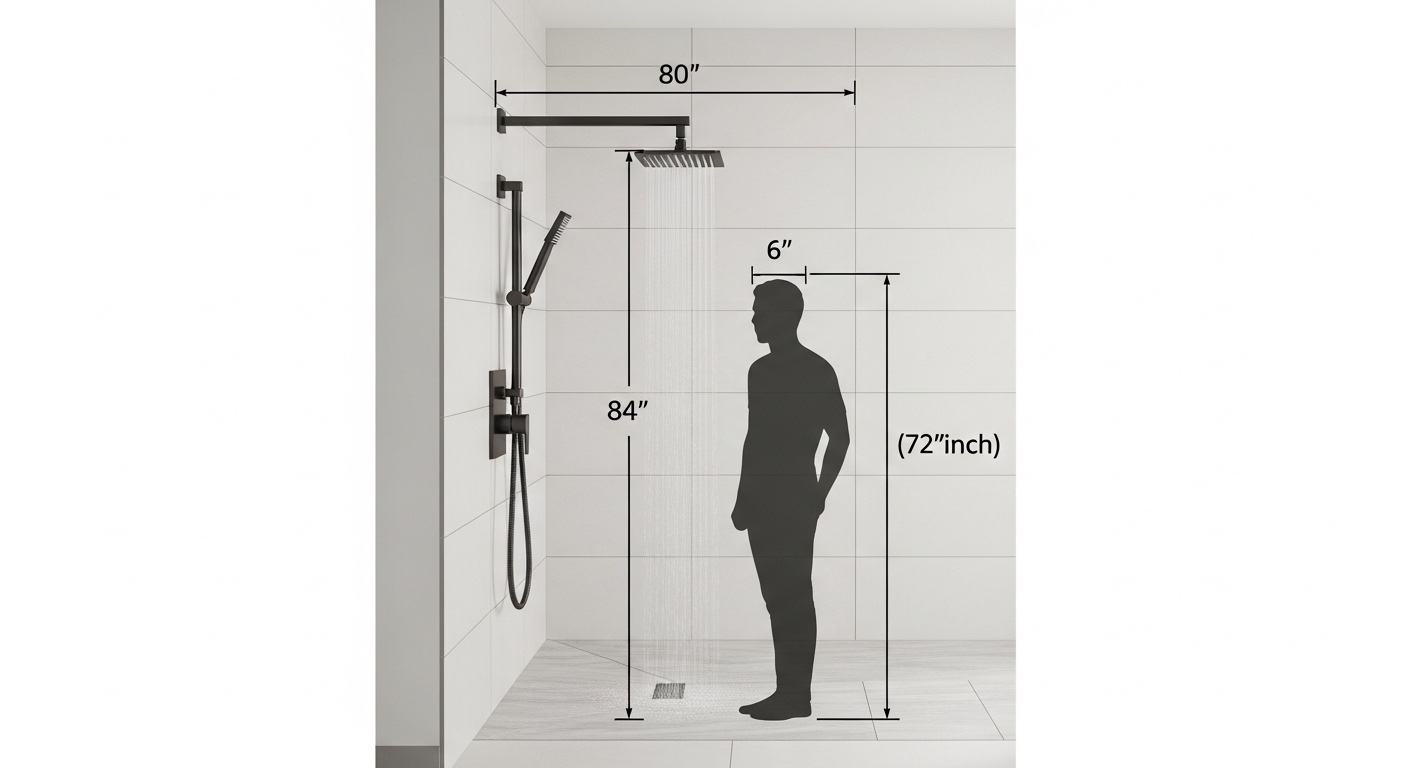
Getting the rainfall shower head mounting height right is the single biggest factor in whether an overhead rain shower feels luxurious or annoying — and it’s the one number most people guess wrong. Unlike a standard angled shower head you can tilt and forget, a rain head sprays straight down, so its height decides whether water lands on your head or your shoulders, whether tall family members duck, and whether the spray still feels like rain instead of a dribble. This guide gives you the exact heights, the math behind them, and how to adapt them for ceiling mounts, tall users, low water pressure, and short ceilings.
How high should a rainfall shower head be mounted from the floor?
For most homes, mount the spray face of a rainfall shower head at 84 inches (7 feet) above the finished floor. That’s the sweet spot: it clears a 6-foot person with a few inches to spare, keeps the whole 8, 10, or 12-inch rain disc raining down on you instead of spraying the wall, and stays low enough that the water still has pressure and warmth when it reaches your body.
Here’s the reasoning. Standard shower heads in the U.S. are roughed in with the shower arm coming out of the wall at about 80 inches. A rain head changes the math because it’s big and flat, and because you usually stand directly under it rather than off to the side. If you install a rain head at that same 80-inch arm height, the actual spray surface can end up right at forehead level for tall users. So the rule of thumb is: the spray face — not the pipe — is what you set to about 84 inches.
Two quick clarifications that trip people up:
- “Finished floor” means the tile, stone, or pan surface you actually stand on — measure after the floor is done, not from the subfloor, or you’ll be off by 1–2 inches.
- Measure to the underside/face of the shower head, where water exits, not to the shower arm or the top of the head. That face is the number your body experiences.
What’s the ideal height for a ceiling-mounted rain shower head?
For a ceiling-mounted rainfall head, set the spray face between 84 and 90 inches above the floor — typically flush or nearly flush with a standard 8-foot (96-inch) ceiling using a short 4–6 inch drop. Ceiling mounts change the geometry: the water falls from directly overhead in a wider, softer pattern, so you can go a touch higher than a wall mount without losing the “standing in the rain” feel.
The trade-off is real, and worth knowing before you cut into the ceiling:
- Higher = softer, wider, more “rainfall” — but colder and lower feeling pressure. Water cools slightly and disperses as it falls, so a head at 90+ inches feels gentler and can feel weak if your water pressure is already low.
- Lower = warmer, more forceful, more “shower.” If you love a strong spray or have modest pressure, keep a ceiling rain head at 84–86 inches.
If you have an 8-foot ceiling, a flush or semi-recessed rain head at roughly 90 inches is the cleanest look and clears almost everyone. If you have a 9-foot ceiling, use a drop pipe (a “shower ceiling arm”) sized to bring the face down to 84–88 inches — don’t leave the head at 108 inches or you’ll be showering in a fine, cool mist.
What if everyone in the house is a different height — how do you pick one number?
Set the height for your tallest regular user plus about 3–4 inches of clearance, because a rain head that’s too low is a daily nuisance for tall people, while a slightly high head is a minor issue everyone else can live with. You can’t tilt a rain head down to “fix” it later, so err upward.
Use this quick reference to convert the tallest user’s height into a target spray-face height:
| Tallest regular user | Recommended spray-face height (from finished floor) | Notes |
|---|---|---|
| 5’4″ and under | 80–82 in | Warmer, stronger feel; good for low pressure |
| 5’5″ – 5’10” | 82–84 in | The most common household setting |
| 5’11” – 6’2″ | 84–86 in | Standard “tall-friendly” height |
| 6’3″ – 6’6″ | 86–90 in | May need a longer shower arm or ceiling mount |
Two practical ways to satisfy a mixed-height household:
- Split the difference high. If your users span 5’4″ to 6’2″, mount at 84 inches. The tall user clears it; the shorter users just stand a little more directly under it.
- Add a slide bar or handheld as a second head. A rain head is fixed, but pairing it with an adjustable handheld on a slide bar gives shorter users, kids, and anyone who wants to rinse without soaking their hair a movable option. If you go this route, our guide on how to install a shower head slide bar yourself walks through the bracket heights and anchoring.
What if my ceiling is only 8 feet — can I still fit a rainfall head?
Yes — an 8-foot (96-inch) ceiling is plenty for a rainfall head; you just mount it as a wall arm reaching up, or a flush ceiling head, with the spray face around 84–90 inches. The mistake people make isn’t ceiling height — it’s using a tall gooseneck arm that eats the clearance and puts the head at forehead level.
Your options with a standard 8-foot ceiling:
- Wall-mount with a rain-style “S” or gooseneck arm. The arm carries the head up and out from an 80-inch rough-in so the face lands near 84 inches. This is the most common retrofit because it reuses your existing in-wall valve and drop.
- Ceiling flush-mount. A short ceiling arm drops the head 4–6 inches from the 96-inch ceiling, putting the face around 90 inches — clean, symmetrical, and out of the way.
- Recessed/semi-recessed panel. The head sits nearly flush in the ceiling; great for tall users and low ceilings, but it requires access above the shower for the plumbing.
Whichever you choose, the mounting height depends on doing the in-wall work correctly first. If you’re roughing in a new shower or moving the valve, get the valve and outlet placement right before you tile — see how to install a shower valve rough-in the right way the first time so your final head height isn’t dictated by a pipe you can’t move.
Does mounting height affect water pressure and how the rain feels?
Yes — the higher you mount a rain head, the softer and cooler the spray feels, because water disperses and loses velocity as it falls. This matters more for rainfall heads than any other type, because rain heads already run at low velocity by design (that’s what makes them feel like rain instead of a jet).
Here’s what actually happens as you raise the head:
- Below ~80 in: forceful, warm, but tall users hit it — feels more like a normal shower than rain.
- 82–84 in: the balance most people want — clearly “rainfall,” still warm and present.
- 86–92 in: luxuriously soft and wide; noticeably cooler; can feel weak if your home pressure is under ~45 psi.
- 94 in and up: misty and gentle; only recommended with strong pressure (50+ psi) and a large-diameter head.
If your water pressure is on the low side, mounting height becomes a lever you can pull. Keep the head lower (82–84 inches), choose a smaller-diameter head (8–10 inches rather than 12+), and pick a model engineered for low-flow performance. We break down exactly how head size, flow rate, and pressure interact in are rainfall shower head taps worth it, and how to pick the right one for low water pressure — read that before you commit to an oversized head that will underperform at any height.
How do you actually measure and mark the mounting height before installing?
Measure from the finished floor straight up to where you want the spray face, then work backward to place the shower arm or ceiling outlet. Do this before tiling or before the drywall closes up, because the in-wall drop and blocking are what lock in your final height.
- Decide your spray-face target (use the table above — most people land at 84 inches).
- Subtract the arm rise. A gooseneck/rain arm lifts the head above the wall outlet — often 8–14 inches of vertical rise. If your arm rises 10 inches, your wall outlet should sit near 74 inches to land the face at 84.
- For ceiling mounts, measure down from the ceiling: on a 96-inch ceiling, a 6-inch drop arm puts the face at 90 inches.
- Add blocking. Install a horizontal 2×6 or 2×8 backer between studs at the outlet location so the arm has something solid to thread into — a heavy rain head cantilevered off a gooseneck needs real support.
- Dry-fit before you tile. Thread the arm in, hold the head up, and stand under it. It’s far cheaper to adjust now than after the wall is closed.
Once the rough-in and tile are done, the visible finish work — the arm, escutcheon, and trim — is straightforward. If you’re also installing the valve trim at the same time, our step-by-step on how to install a shower faucet trim kit covers sealing and alignment so the whole wall looks intentional.
Quick comparison: wall-mount vs. ceiling-mount rain head heights
| Factor | Wall-mount (gooseneck arm) | Ceiling-mount |
|---|---|---|
| Typical spray-face height | 82–86 in | 84–90 in |
| Feel | Warmer, more forceful | Softer, wider, more “rain” |
| Best ceiling height | Any (8 ft works great) | 8 ft flush, 9 ft with drop arm |
| Retrofit difficulty | Easy — reuses wall drop | Harder — needs ceiling access |
| Tall-user friendly | Good to ~6’2″ | Best for 6’2″+ |
| Low-pressure friendly | Yes, at 82–84 in | Only at lower heights |
FAQ
Is 80 inches too low for a rainfall shower head?
For a standard angled head, 80 inches is fine, but for a rainfall head it’s usually too low — the flat spray face ends up near forehead height for anyone 5’10” or taller. Because a rain head sprays straight down and can’t be tilted, aim the spray face for 84 inches and use 80 inches only if all users are 5’4″ or shorter.
How much clearance should there be between the shower head and my head?
Aim for about 3–6 inches between the spray face and the top of your tallest regular user’s head. That keeps the head out of the way while still letting the water land squarely on top of you rather than spraying past. Less than 3 inches feels cramped; more than about 10 inches starts to cool and weaken the spray.
Can I raise an existing rain head that’s mounted too low?
Sometimes, without opening the wall. Swap the straight shower arm for a taller gooseneck or “S”-shaped rain arm, which can add 6–14 inches of rise from the same wall outlet. If that’s still not enough, or the outlet itself is too low, you’ll need to relocate the in-wall drop — a bigger job that means opening the wall and re-tiling.
Does a bigger rainfall head need to be mounted higher?
Not higher — often the opposite. A large 12-inch head disperses water over a wide area and loses pressure as it falls, so mounting it too high makes it feel weak. Keep larger heads at 82–86 inches, especially if your water pressure is under 45 psi, so the spray still feels full-bodied.
What mounting height works best for low water pressure?
Keep the spray face lower — around 82–84 inches — so water has less distance to fall and lose velocity, and pair it with a smaller 8–10 inch head rated for low flow. Height is the easiest free adjustment you can make to preserve pressure feel; combine it with a pressure-friendly head design for the best result.
Should the rain head be centered over the middle of the shower or toward the drain?
Center it over where you’ll actually stand — usually the middle of the shower floor, slightly toward the wall opposite the entry so you step into the spray rather than getting hit at the door. Keep it a few inches away from the glass or curtain so the wide rain pattern doesn’t splash out.
A note on getting this right the first time
Author note: This guide was written by the wewefaucet product team, who spec, test, and install shower systems for a living. We measured real spray-face heights against user heights and water-pressure readings rather than repeating the generic “80-inch” rule, because rainfall heads genuinely behave differently from standard heads. About wewefaucet: we design and sell faucets, shower heads, and bathroom fixtures direct to homeowners at www.wewefaucet.net, and our rainfall heads are pressure-tested and backed by a limited warranty. For plumbing rough-in dimensions we follow standard U.S. residential practice; always confirm your local plumbing code and the manufacturer’s installation instructions, and check the flow-rate rating (U.S. shower heads are capped at 2.5 GPM under federal standards) before you buy. If you want to see how different mounting heights and spray patterns look in practice before committing, our breakdown of what a rainfall shower head video actually tells you before you buy is a useful visual companion to the numbers above.
您好!please sign in