 WEWE Kitchen Faucets
Is the Grohe Eurosmart Pull Out Kitchen Faucet Worth Buying in 2026?
Views:232 classificationProduct
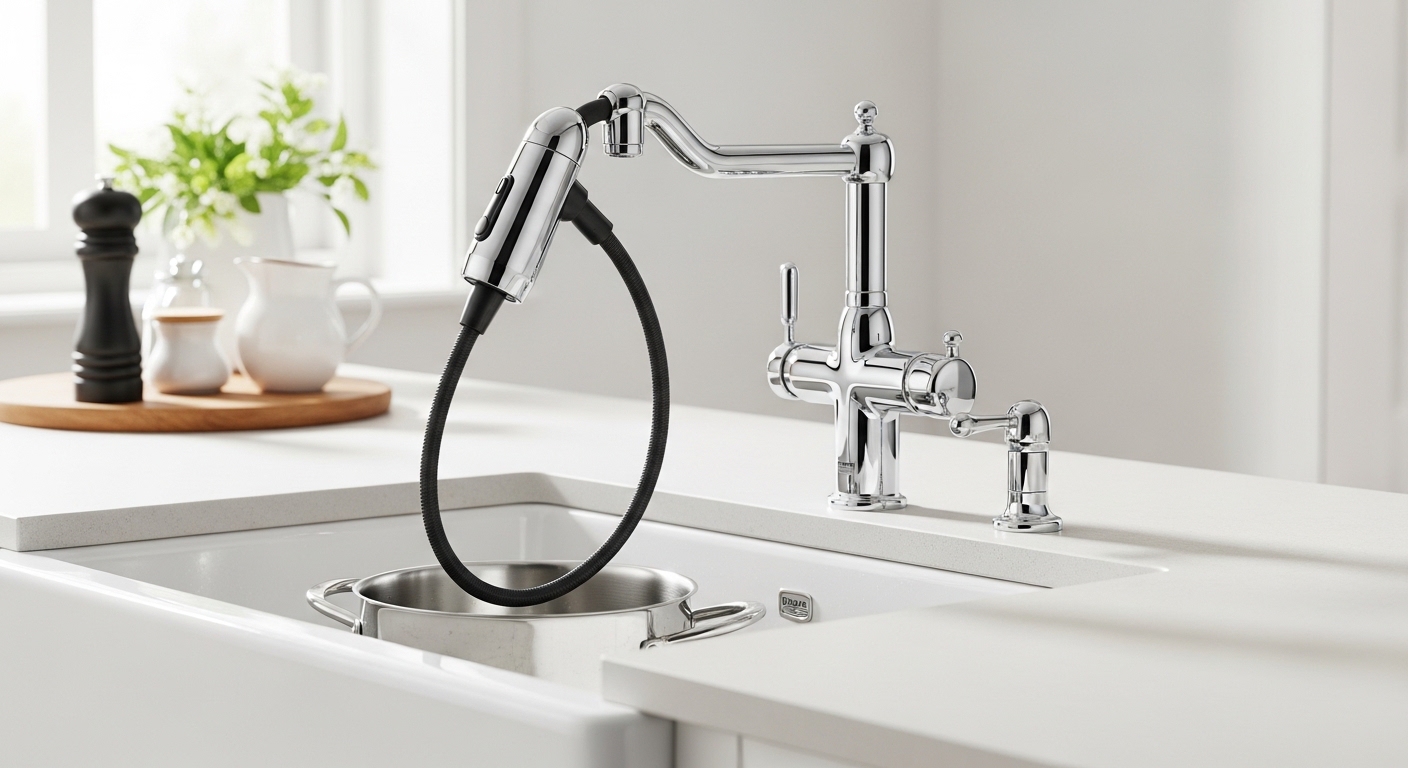
If you’ve been comparing mid-range kitchen faucets, you’ve almost certainly landed on the grohe eurosmart pull out kitchen faucet — and you’re probably wondering whether the Grohe name actually earns its price, or whether you’re paying for a badge. Short version: you’re mostly paying for the engineering underneath. Grohe builds the Eurosmart around the same ceramic cartridge tech, SilkMove handle feel, and StarLight chrome plating it uses on pricier lines, then trims the styling and features to hit a friendlier price. Below, we’ll walk through exactly who this faucet is for, how the “pull out” design differs from a pull-down, what the specs really mean at the sink, and where it beats — or loses to — the competition.
What exactly is the Grohe Eurosmart pull out kitchen faucet?
It’s a single-handle kitchen faucet with a low-to-medium C-spout and a wand that pulls straight out toward you (not down from a high arc), giving you an aerated stream and a spray mode from the same head. The Eurosmart line is Grohe’s entry-to-mid tier — designed for everyday durability at a sane price rather than showroom drama.
The “pull out” distinction matters more than people expect. A pull-out spout sits lower and the wand extends horizontally, which makes it easy to fill pots off to the side, rinse a wide sink, and work under low upper cabinets or a window. A pull-down faucet, by contrast, has a tall gooseneck and the wand drops vertically into the basin. If your sink sits under a window or a shelf, the Eurosmart’s lower profile is a real advantage — you won’t smack the spout every time you swing it.
Key hardware you’re actually buying:
- Ceramic cartridge — Grohe’s drip-resistant valve that gives that smooth, no-grind handle motion (Grohe brands the feel “SilkMove”).
- Dual spray wand — a normal aerated stream plus a punchier spray, toggled with a button on the head.
- StarLight chrome or matte finishes — a plating process rated to resist tarnish and scratching; also offered in stainless-look and matte black on many SKUs.
- Flexible braided hose with a counterweight for smooth retraction back into the spout.
- Aerator typically flowing around 1.75 GPM (some regional versions run 1.5 GPM for stricter water codes).
Is a pull-out faucet like the Eurosmart better than a pull-down for a small kitchen?
For a small or window-facing kitchen, yes — a pull-out like the Eurosmart is usually the smarter pick. Its lower spout height (commonly 8–9 inches to the aerator versus 15+ inches on tall pull-downs) means it fits under cabinets and windowsills that would block a gooseneck, and the horizontal wand reaches into a compact single-bowl sink without splashing.
Where a pull-down wins is filling tall stockpots and rinsing a big three-tier sink — the extra height and vertical drop give you more clearance and a longer natural reach into a deep basin. So the honest rule of thumb: tight space, low clearance, or a shallow sink → pull-out Eurosmart; big open kitchen with a deep sink and no obstructions → consider a pull-down. If you’re still unsure which physical size fits your basin and deck, our guide on what size faucet for a kitchen sink you actually need walks through spout height, reach, and single- vs. three-hole mounting before you commit.
How much does the Grohe Eurosmart pull out kitchen faucet cost, and what do you get for the money?
Expect roughly $180 to $260 depending on finish and retailer, with chrome usually cheapest and matte black or SuperSteel commanding a premium. For that money you get German ceramic-cartridge reliability, a real dual-spray pull-out, and Grohe’s lifetime limited warranty — which is the part that quietly justifies the price over a $70 no-name faucet.
Here’s the value math most buyers miss: cheaper faucets often fail at the cartridge or the spray-hose retraction within a couple of years, and replacing a $70 faucet twice costs more (in money and Saturday afternoons) than buying one solid unit once. If you want a broader look at where quality meets price across brands, our roundup of the best value kitchen sink faucets puts the Eurosmart in context against its direct rivals.
How does the Eurosmart compare to Grohe Concetto, Kraus, and Delta?
The Eurosmart is Grohe’s value line; step up to Concetto and you get a taller, more contemporary silhouette and often a higher-arc pull-down. Against Kraus and Delta, the Eurosmart trades flashy features (magnetic docking, touch/touchless) for German cartridge feel and a simpler, quieter mechanism. Here’s the quick comparison:
| Faucet | Type | Spout style | Typical price | Standout feature | Warranty |
|---|---|---|---|---|---|
| Grohe Eurosmart Pull Out | Pull-out | Low/medium C-spout | $180–$260 | SilkMove ceramic cartridge, low profile | Lifetime limited |
| Grohe Concetto | Pull-down | Tall gooseneck | $250–$400 | 360° swivel, modern high-arc look | Lifetime limited |
| Kraus Oletto | Pull-down | Gooseneck | $130–$200 | Dual-function head, budget-friendly | Limited lifetime |
| Delta (comparable pull-down) | Pull-down | Tall arc | $150–$300 | MagnaTite docking, Touch2O options | Lifetime limited |
If you specifically want a gooseneck pull-down at a lower price point, it’s worth reading our full take on whether the Kraus Oletto pull-down is worth buying before you decide — it’s the Eurosmart’s most common cross-shop, and the two suit genuinely different sinks.
The pattern in that table is clear: Grohe sells feel and longevity; Delta and Kraus sell features and value. Neither is wrong — it depends on whether you’d rather have touchless activation or a cartridge that still feels buttery after eight years.
How do you install a Grohe Eurosmart pull out kitchen faucet yourself?
Most homeowners can install the Eurosmart in about 45–90 minutes with basic tools — it’s a standard single-hole deck-mount faucet, so if you’ve ever swapped a faucet before, nothing here will surprise you. The trickiest parts are working in the tight cabinet space under the sink and getting the supply connections leak-free.
- Shut off the water at the under-sink stops and open the old faucet to relieve pressure.
- Disconnect and remove the old faucet — a basin wrench is your best friend for the mounting nuts.
- Feed the Eurosmart’s hoses and shank through the deck hole; use the included gasket/base plate if your sink has a single hole (or a 3-hole escutcheon if needed).
- Tighten the underside mounting nut so the faucet sits flush and doesn’t rotate.
- Connect the supply lines to the hot and cold stops — hand-tight plus a quarter turn, don’t gorilla it.
- Attach the pull-out hose to the wand and clip on the counterweight per the diagram.
- Turn the water back on slowly, remove the aerator, and flush for 30 seconds to clear debris before checking for leaks.
Two real-world tips: first, confirm your supply lines actually reach and match the connections — if you’re replacing an older faucet, double-check sizing with our guide on how to measure faucet supply line size so you’re not stuck mid-install. Second, if the spray wand ever stops retracting smoothly later on, that’s almost always a counterweight or hose-routing issue, not a defect — the same fix logic in our walkthrough on why a pull-down faucet won’t retract applies directly to the Eurosmart’s pull-out hose.
Is the Eurosmart good for hard water, and how do you keep it clean?
It handles hard water better than most budget faucets because the aerator and spray nozzles use flexible rubber “SpeedClean” nipples — you just rub off mineral buildup with your thumb, no soaking required. The ceramic cartridge is also more scale-tolerant than older rubber-washer valves, which is a big reason Grohe can offer a lifetime warranty on the mechanism.
That said, no faucet is immune to hard water. If you’re on well water or a high-mineral municipal supply, plan on:
- Wiping the finish dry after heavy use to prevent spotting (StarLight chrome resists it but doesn’t cheat chemistry).
- Rubbing the spray nozzles clean monthly if the spray pattern starts wandering.
- Unscrewing and vinegar-soaking the aerator once or twice a year if flow drops.
If you’re seeing discolored or gritty water regardless of the faucet, that’s a plumbing issue, not the fixture — our piece on why rust comes out of a faucet covers how to diagnose it fast before you blame the hardware.
What are the real downsides of the Grohe Eurosmart pull out?
The honest drawbacks: it’s a lower-profile faucet, so filling tall pots directly under the spout is tighter than with a gooseneck; the entry-tier Eurosmart doesn’t offer touchless or magnetic docking; and finish availability varies by region, so the exact matte black or SuperSteel you want may cost more or ship slower. The plastic spray wand head (common at this price across all brands) also feels less premium than an all-metal one.
None of these are dealbreakers — they’re the trade-offs that keep the price reasonable. Just go in knowing the Eurosmart is a reliable everyday faucet, not a feature-loaded flagship. If touchless activation is a must-have, you’re shopping in a different category entirely, and it’s worth seeing what real users recommend in our rundown of the best touchless kitchen faucets Reddit actually recommends.
Who should buy the Grohe Eurosmart pull out kitchen faucet?
Buy it if you want a set-it-and-forget-it faucet: a renter-friendly-to-remodel upgrade, a small or window-facing kitchen, or anyone who values a smooth cartridge and a real warranty over gimmicks. Skip it if you specifically need a tall gooseneck for deep pots, want touchless tech, or you’re furnishing a big open kitchen where a dramatic high-arc pull-down would look and function better.
In plain terms: the Eurosmart is the faucet you recommend to a friend who says “I just want something good that won’t drip or die in two years and doesn’t cost a fortune.” That’s exactly the lane Grohe built it for, and it delivers.
FAQ
Does the Grohe Eurosmart pull out come in finishes other than chrome?
Yes. Chrome is the most widely stocked and cheapest, but many SKUs are available in SuperSteel (brushed stainless look) and matte black, and occasionally other finishes depending on region. All use Grohe’s PVD/StarLight plating rated to resist tarnishing and scratching, so the darker finishes hold up well against daily wiping.
What’s the flow rate of the Eurosmart pull out faucet?
Most versions flow around 1.75 GPM at 60 psi, with some regional models limited to 1.5 GPM to meet stricter water-efficiency codes (like California’s). The aerated stream feels full despite the restriction because of Grohe’s aerator design, and the spray mode concentrates the same flow into a stronger rinse.
Is the Grohe Eurosmart pull-out hose replaceable if it wears out?
Yes — the braided pull-out hose and the wand are serviceable parts. Grohe sells replacement hoses and cartridges, and the lifetime limited warranty covers the mechanism against defects for the original owner. If the wand ever won’t retract, check the counterweight and hose routing first; that solves the vast majority of retraction complaints without any parts at all.
Will the Eurosmart fit a standard single-hole sink?
Yes. It’s designed as a single-hole deck-mount faucet and includes a base plate (escutcheon) so it can also cover a standard 3-hole sink configuration. Standard deck thickness and a 1⅜-inch mounting hole are all you need — no special sink required.
How does the Eurosmart compare to a cheaper pull-down like the Kraus Oletto?
The Kraus Oletto is a taller gooseneck pull-down at a lower price with a punchy dual-function head, while the Eurosmart is a lower-profile pull-out with a smoother German ceramic cartridge and Grohe’s warranty pedigree. Choose the Oletto for a big open sink and maximum pot clearance on a budget; choose the Eurosmart for a compact or window kitchen where you want long-term cartridge feel and reliability.
Is the Grohe Eurosmart pull out kitchen faucet worth it over a $70 generic faucet?
For most kitchens, yes. The generic faucet often costs less upfront but tends to fail at the cartridge or spray-hose retraction within a couple of years, while the Eurosmart’s ceramic cartridge and lifetime limited warranty make it a genuine buy-it-once fixture. You’re paying for engineering and longevity, not just the badge.
Author note: This guide was written by the wewefaucet product team — plumbing-fixture specialists who install, pressure-test, and disassemble kitchen and bath faucets year-round to see how cartridges, hoses, and finishes actually hold up in real homes. About wewefaucet: we’re a dedicated faucet and bathroom-fixture retailer at www.wewefaucet.net, focused exclusively on faucets, showers, and sink hardware — not a general home store. Our recommendations weigh independent durability testing, industry standards (ceramic-cartridge cycle ratings and NSF/ANSI-style lead-safe and flow-rate criteria), and manufacturer warranty terms, so you can buy once and buy right.
您好!please sign in