 WEWE Kitchen Faucets
What Is a Centerset Faucet, and Is It the Right Choice for Your Bathroom Sink?
Views:249 classificationProduct
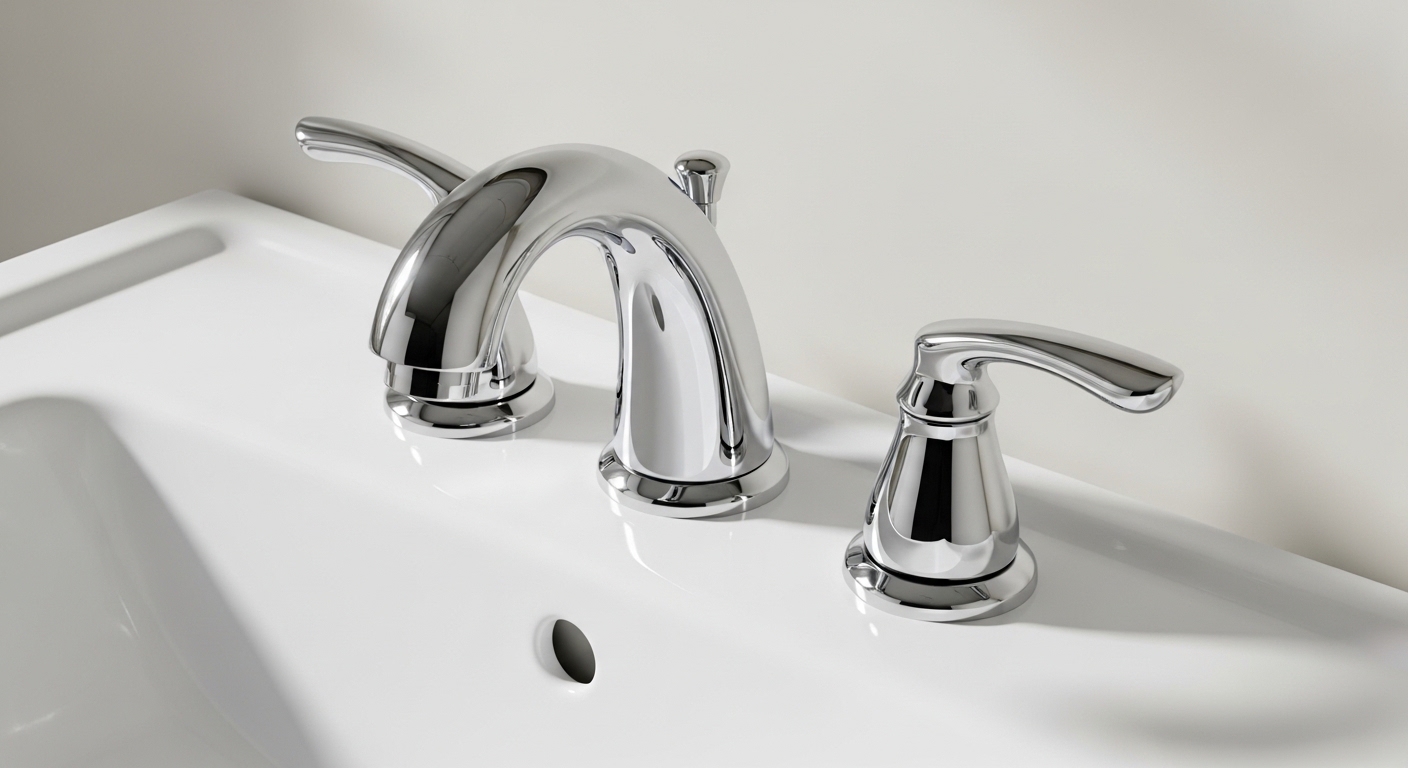
If you’ve ever stood in a Home Depot aisle squinting at boxes labeled “4-inch centerset” and wondered exactly what is a centerset faucet and whether it fits your sink, you’re not alone — it’s the single most-asked question we get from homeowners shopping for a bathroom upgrade. The short version: a centerset faucet is a three-hole bathroom faucet where the spout and handles sit on one connected deck plate, spaced 4 inches center-to-center between the two outer holes. It’s the default style for the vast majority of standard American bathroom sinks built in the last 40 years, and unless your sink was custom-fabricated or designed for a widespread or wall-mount setup, this is almost certainly what you need.
But “fits the sink” is just the starting point. The right centerset faucet decision involves handle configuration, valve type, finish durability, flow rate, ADA compliance, and warranty terms — and getting any of those wrong means either a leaky install in 18 months or a faucet that looks dated the moment you mount it. This guide walks through everything a real shopper actually needs to know, written from years of testing fixtures at wewefaucet and answering the same questions over and over again from customers who got burned by cheap big-box buys.
How do I know if I need a 4-inch centerset faucet or something else?
Measure the distance between the centers of the two outer holes in your sink. If it’s exactly 4 inches, you need a centerset faucet. If the holes are 6 to 16 inches apart, you need a widespread faucet (three separate pieces). If there’s only one hole, you need a single-hole faucet. That measurement is the only thing that determines compatibility — finish, handle style, and brand are all secondary decisions.
The 4-inch standard exists because the American sink industry essentially standardized around it in the mid-20th century, when two-handle plumbing was universal. Today, even when manufacturers ship sinks with three pre-drilled holes spaced for centerset use, a lot of buyers don’t realize they have options within that footprint. You can install:
- A true two-handle centerset — separate hot and cold handles, traditional look, slightly higher flow control precision.
- A single-handle centerset — one lever in the middle, with the two outer holes covered by the base plate (the spout’s mounting plate hides them). Cleaner look, easier one-handed operation.
- A “mini-widespread” or convertible faucet — looks like a widespread but spaced for 4-inch holes. More expensive, more visually upscale.
If your sink has three holes 8 inches apart and you try to force a centerset into it, you’ll have two exposed holes and a base plate that doesn’t reach. Conversely, dropping a widespread into a centerset-drilled sink leaves the handles awkwardly squeezed together. Measure first, shop second.
What’s the difference between a centerset, widespread, and single-hole faucet?
The difference comes down to how many holes the faucet uses and how those pieces connect underneath the sink. A centerset is one unified piece across three holes 4 inches apart; a widespread is three separate pieces across three holes 6-16 inches apart; a single-hole faucet uses one piece in one hole. Each has trade-offs in price, install complexity, and aesthetic.
| Faucet Type | Hole Spacing | # of Holes | Typical Price Range | Best For | Install Difficulty |
|---|---|---|---|---|---|
| Centerset (4″) | 4 inches | 3 (unified) | $40 – $250 | Standard bathroom sinks, powder rooms, rental properties | Easy (30-60 min) |
| Mini-widespread | 4 inches | 3 (separate pieces) | $120 – $400 | Small sinks wanting an upscale look | Moderate |
| Widespread | 6 – 16 inches | 3 (separate pieces) | $150 – $800+ | Larger vanities, master baths, luxury installs | Moderate to hard |
| Single-hole | N/A | 1 | $50 – $500 | Modern vessel sinks, minimalist designs | Easiest |
| Wall-mount | Varies | 0 (in countertop) | $200 – $1000+ | Vessel sinks, custom designs, freestanding tubs | Hard (requires in-wall plumbing) |
The single biggest reason centersets dominate the market is the all-in-one base plate. Because the spout and both handles share a single chassis, the underside connections are pre-assembled at the factory — you only have two supply lines and one drain rod to hook up. A widespread requires you to connect three separate pieces under the sink, often in cramped vanity cabinets, with flexible underbody tubing that has to seal at multiple points. For most DIYers, a centerset install is a one-evening job; a widespread can take half a Saturday.
What are the pros and cons of a centerset faucet in a real bathroom?
The biggest pro is value: you get a complete, finished-looking faucet for $40-$150 in most cases, with simpler installation and easier repairs. The biggest con is aesthetic limitation — centersets look “standard,” and on a large or premium vanity, they can feel undersized or builder-grade compared to a widespread.
Here’s the honest trade-off matrix from someone who installs these regularly:
- Pro — Compact footprint: Ideal for sinks under 24 inches wide, powder rooms, half-baths, and tight vanities where a sprawling widespread would crowd the basin.
- Pro — Easier cleaning: The unified base plate has one perimeter to wipe around, not three. Soap scum and toothpaste splatter don’t get trapped between handle bases.
- Pro — Lower install cost: Plumbers typically charge $80-$150 for a centerset swap vs. $150-$300 for a widespread, because the under-sink work is simpler.
- Pro — Wide selection: Every major brand makes dozens of centerset models in every finish.
- Con — Limited style ceiling: Premium designer collections often skip the centerset format entirely. If you want a high-arc gooseneck on a 36-inch vanity, you’ll want widespread.
- Con — Handle spacing feels tight: On two-handle versions, your hand can hit the spout when turning a handle. Not a dealbreaker, but noticeable.
- Con — Base plate hides damage: If water seeps under the plate over years, you may not see corrosion on the sink deck until you remove the faucet.
What should I look for when buying a centerset faucet under $200?
Under $200, prioritize a solid brass body, a ceramic disc cartridge valve, a lead-free certification (NSF/ANSI 61 and 372), and at least a limited lifetime warranty on the finish and cartridge. Skip anything with a zinc alloy body, plastic internals, or a “5-year limited” warranty — those are the cheap-build tells.
Here’s what matters and what doesn’t when you’re shopping the realistic mid-market price band where most homeowners actually buy:
Body material
Solid brass is the gold standard. It resists corrosion, holds threads cleanly for repairs, and lasts 20+ years in normal use. Zinc alloy (often marketed as “metal” without specifying) is brittle, corrodes from the inside out in 5-8 years with hard water, and is the #1 reason cheap faucets fail at the spout base. If the spec sheet doesn’t explicitly say “solid brass” or “lead-free brass,” assume it’s zinc. We dig deeper into this in our breakdown of brass vs zinc faucets and which lasts longer.
Valve type
Ceramic disc cartridges are the modern standard — they handle 500,000+ on/off cycles, resist sediment, and rarely drip. Older compression valves (with rubber washers) are still around in budget models and will need washer replacements every 2-3 years. If the listing says “drip-free ceramic” or “ceramic cartridge,” you’re good.
Finish
PVD (Physical Vapor Deposition) finishes — common on brushed nickel, matte black, and champagne bronze — are vastly more durable than electroplated finishes. They resist scratches, tarnishing, and the cleaning-product damage that ruins cheaper coatings. Polished chrome remains the most scratch-resistant traditional finish and the easiest to clean.
Flow rate
Federal law caps bathroom faucets at 2.2 GPM, but most modern centersets ship at 1.2 or 1.5 GPM to meet WaterSense standards and California/Colorado/New York stricter codes. Lower flow saves water without affecting hand-washing performance — your perceived “pressure” comes from the aerator, not raw flow. For a fuller explanation, see our guide on what GPM in faucets actually means.
Lead-free certification
Look for NSF/ANSI 61 (drinking water safety) and NSF/ANSI 372 (lead-free, ≤0.25% weighted average lead content). These are required by U.S. federal law for any faucet that delivers water for drinking or cooking — but enforcement varies, and gray-market imports sometimes skirt it. Verifying this matters more than people realize; here’s how to identify lead-free bathroom faucets before you buy.
Which finishes work best on a centerset faucet?
For 2026, the top-performing centerset finishes are brushed nickel, matte black, polished chrome, and champagne bronze — in roughly that order of popularity. Brushed nickel hides water spots and fingerprints best; polished chrome is the most durable and easiest to clean; matte black is visually striking but shows hard-water deposits fastest; champagne bronze and brushed gold are the rising premium picks.
| Finish | Best Bathroom Style | Hides Water Spots | Scratch Resistance | Cleaning Difficulty | 2026 Trend Status |
|---|---|---|---|---|---|
| Polished Chrome | Traditional, transitional, modern | Poor | Excellent | Very easy | Timeless classic |
| Brushed Nickel | Transitional, farmhouse, traditional | Excellent | Very good | Easy | Still the bestseller |
| Matte Black | Modern, industrial, contemporary | Good (no spots, shows minerals) | Good (PVD) | Moderate | Peak popularity |
| Champagne Bronze | Modern farmhouse, transitional | Very good | Very good (PVD) | Easy | Rising fast |
| Oil-Rubbed Bronze | Traditional, rustic, Tuscan | Good | Variable | Moderate | Declining — see our trend analysis |
| Brushed Gold | Glam, modern luxury | Very good | Good (PVD) | Easy | Premium niche |
If you’re stuck deciding, brushed nickel is the safest bet — it works with every cabinet color, hides fingerprints, and won’t look dated in five years. For a deeper dive on finish trends, see whether oil-rubbed bronze is out of style in 2026.
Can I install a centerset faucet myself, and what’s the process?
Yes — a centerset is the easiest bathroom faucet to install, usually taking 30-60 minutes with basic tools. You’ll need an adjustable wrench, plumber’s tape, a basin wrench (helpful but not always required), and a flashlight. The hardest part is working in the tight cabinet space under the sink, not the connections themselves.
Here’s the realistic step-by-step:
- Shut off water at the angle stops under the sink (both hot and cold), then open the old faucet handles to relieve pressure.
- Disconnect supply lines from the angle stops. Place a small bucket — there’s always a cup of residual water.
- Remove the old faucet: from under the sink, unscrew the mounting nuts holding the faucet body to the deck. A basin wrench earns its keep here.
- Clean the sink deck thoroughly — old caulk, mineral deposits, and silicone all need to go before the new gasket seats properly.
- Set the new faucet: most centersets ship with a rubber or silicone base gasket; some require a thin bead of clear plumber’s silicone underneath. Check the manual.
- Tighten mounting nuts from below — snug, not gorilla-tight (you can crack the deck or the gasket).
- Connect supply lines to the angle stops. Use new braided stainless steel supply lines — don’t reuse old ones. Plumber’s tape on the threads (3-4 wraps clockwise).
- Install the drain pop-up assembly if included.
- Turn water back on slowly, check for leaks at every connection, run hot and cold for a full minute to clear debris from the aerator.
Two install gotchas the box manuals don’t warn you about: first, check the height of your supply lines before you buy — if your angle stops are unusually low, the standard 20-inch supply lines included with most centersets may not reach. Second, the aerator on a brand-new faucet often catches sediment from the lines during the first run — unscrew it, rinse, and reinstall if pressure feels weak. If you want to skip the labor cost, our guide on how to save money on faucet installation covers what to negotiate with a plumber.
Are centerset faucets ADA compliant?
Single-handle centerset faucets with lever handles meet ADA requirements when installed at the proper height (spout outlet 34 inches max from floor for accessible sinks). Two-handle centersets technically meet ADA requirements only if the handles are lever-style (not knob/cross handles) and require less than 5 pounds of force to operate. Touchless and motion-activated centersets are the most universally accessible option.
For rental properties, multi-family housing, and aging-in-place renovations, lever-handle single-control centersets are the standard recommendation. They allow one-handed operation, can be operated with a closed fist or elbow, and meet the ADA 2010 Standards for Accessible Design (Section 606.4).
How long should a centerset faucet last?
A well-made centerset faucet with a solid brass body and ceramic disc cartridge should last 15-25 years in normal residential use. Cheap zinc-body faucets often fail within 5-10 years, usually from internal corrosion or cartridge failure. The cartridge itself is the most common service item and can typically be replaced for $15-$40 in parts without removing the faucet.
Lifespan depends heavily on three factors:
- Water quality: Hard water (high mineral content) shortens aerator and cartridge life. A whole-house softener or a quality faucet aerator with anti-scale coating helps significantly.
- Cleaning products: Abrasive cleaners and acidic descalers strip finishes. Use mild dish soap and a soft cloth; reserve vinegar for occasional aerator soaks only.
- Build quality: Brand and warranty terms are reliable proxies. A limited lifetime warranty on the finish and cartridge signals that the manufacturer expects 20+ years of service.
Understanding what warranty language actually protects you against matters — many “lifetime” warranties exclude commercial use, hard water damage, and labor. Check our explainer on understanding faucet warranty terms before you buy for the fine-print red flags.
Is a centerset faucet the best choice for a small bathroom or powder room?
Yes — a centerset is almost always the right answer for bathrooms under 40 square feet, powder rooms, and any sink under 22 inches wide. The compact footprint maximizes counter space, the lower price frees budget for tile or mirror upgrades, and the wide style selection means you can match any design from traditional to ultra-modern.
The only times we’d steer a small-bath shopper away from a centerset are: (1) if the existing sink is single-hole pre-drilled, in which case use a single-hole faucet, (2) if you’re installing a vessel sink, where a tall single-hole or wall-mount looks better, or (3) if the vanity is a statement piece where a designer widespread justifies the visual upgrade. For most renovations, a quality centerset at $80-$180 delivers 90% of what a $400 widespread does, with simpler installation and easier future maintenance.
FAQ
Does a centerset faucet require 1 or 3 holes in the sink?
A centerset faucet requires 3 holes spaced 4 inches center-to-center between the two outer holes. The middle hole is for the spout, and the outer two are for either handles (on a two-handle model) or covered by the base plate (on a single-handle model with a unified deck).
Can I put a single-hole faucet on a centerset (3-hole) sink?
Yes — buy a single-hole faucet that includes an optional deck plate (sometimes called an “escutcheon plate”) sized for 4-inch centerset sinks. This covers the two unused outer holes and gives a clean finished look. Most single-hole faucets sold today include this plate as an option in the box.
What’s the difference between a 4-inch centerset and a 4-inch minispread?
A 4-inch centerset has all three pieces connected on one base plate. A 4-inch minispread (or mini-widespread) has the same hole spacing but three separate pieces (two handles and a spout) that aren’t visually connected on top — giving the upscale look of a widespread on a centerset-drilled sink. Minispreads cost roughly 2-3x more than basic centersets.
Are centerset faucets out of style in 2026?
No — centerset faucets remain the bestselling bathroom faucet category in North America and continue to dominate new construction and remodels in standard bathrooms. The format isn’t a “trend”; it’s the default. Style updates happen at the finish and handle level (matte black, lever handles, champagne bronze) rather than abandoning the centerset configuration.
How much does it cost to have a plumber install a centerset faucet?
Typical plumber labor for swapping a centerset faucet runs $80-$200 depending on region, with most jobs in the $100-$150 range. The work usually takes 45-90 minutes. Costs go up if angle stops need replacement, supply lines are corroded, or the existing faucet is seized in place from mineral buildup.
Why is my new centerset faucet leaking from the base after installation?
Almost always one of three causes: the mounting nuts underneath aren’t tight enough, the rubber gasket between the base plate and sink deck is misaligned, or the deck wasn’t fully cleaned of old silicone before installation. Shut off the water, remove the faucet, clean both surfaces with rubbing alcohol, and reinstall with a fresh bead of clear plumber’s silicone if your manual recommends it.
Can I use a centerset faucet on a kitchen sink?
Technically yes if your kitchen sink has 4-inch hole spacing, but it’s uncommon. Kitchen sinks typically use 8-inch widespread spacing, single-hole modern designs, or larger 3- or 4-hole configurations with a side sprayer. Bathroom centersets also have lower flow rates (1.2-1.5 GPM) than kitchen faucets (1.8-2.2 GPM), making them slow for filling pots.
About the author: This guide was written by the wewefaucet product team, which has spent over a decade designing, sourcing, and testing residential bathroom and kitchen fixtures sold across North America. Every faucet we ship undergoes pressure testing to 1,000 PSI, salt-spray corrosion testing per ASTM B117, and cartridge cycle testing to verify 500,000+ on/off cycles before release. All wewefaucet bathroom faucets are NSF/ANSI 61 and 372 certified for lead-free drinking water safety, cUPC listed, and backed by a limited lifetime warranty on the finish and cartridge.
您好!please sign in