 WEWE Kitchen Faucets
Is a Brass Faucet Valve Cartridge Really Worth It, or Should You Just Buy Ceramic?
Views:22 classificationProduct
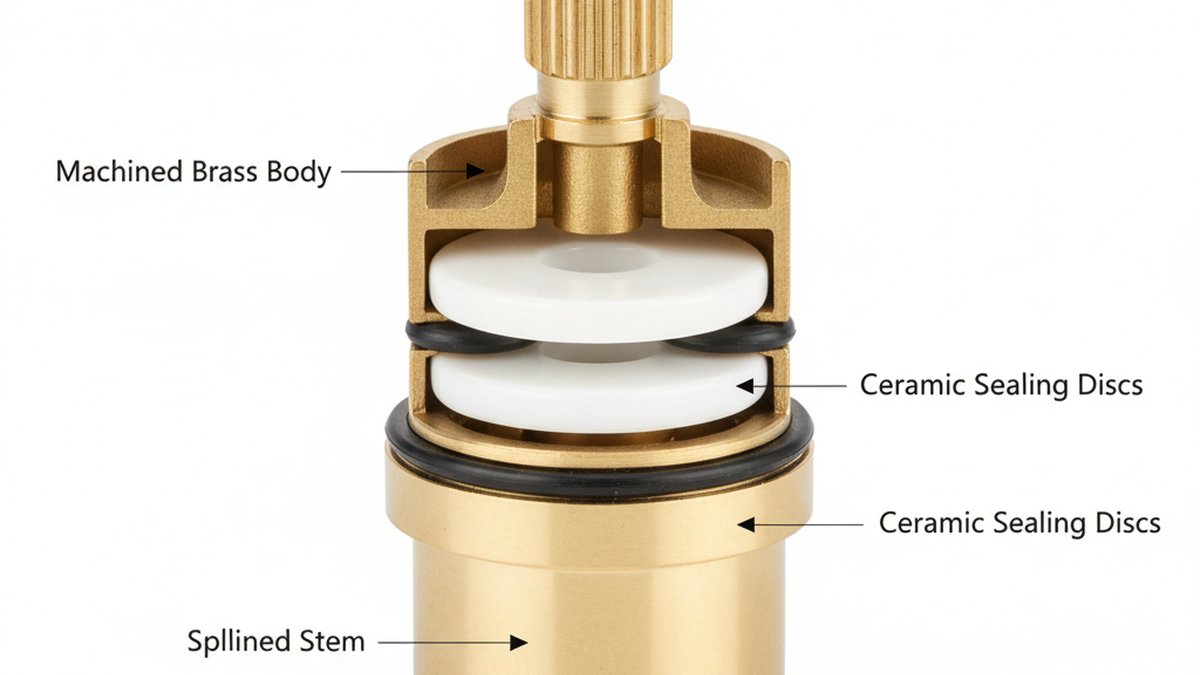
If you’ve been staring at replacement parts and wondering whether a brass faucet valve cartridge is a real upgrade or just marketing on the packaging, here’s the honest answer: brass matters most for the housing and the moving contact surfaces, because it shrugs off corrosion, handles hot water without warping, and can be machined to tight tolerances. What actually stops the drip is the sealing mechanism inside — ceramic discs, rubber washers, or an O-ring stack. The best-performing cartridges combine both: a brass shell with ceramic sealing discs. That’s the combination we recommend to most shoppers at wewefaucet, and below we’ll walk through exactly when brass is the right call, when it isn’t, and how to pick one that fits your faucet the first time.
What exactly is a brass faucet valve cartridge, and what does it do?
A faucet valve cartridge is the removable core inside your faucet that controls water flow and temperature — and a “brass” one simply means that core’s body (and often its internal moving parts) is made from machined brass instead of plastic or a plastic-brass hybrid. When you lift or turn the handle, you’re moving the cartridge; it opens, mixes hot and cold, and shuts off the water. Everything else on the faucet is basically plumbing and decoration around this one part.
Inside the cartridge, the real sealing work is done one of two ways. Older-style and budget cartridges use a rubber washer or O-ring pressed against a seat — simple, cheap, and easy to replace, but the rubber compresses and hardens over time, which is why those faucets start dripping. Modern cartridges use two polished ceramic discs; one stays fixed, one rotates, and when their solid faces line up the water shuts off completely. Ceramic barely wears at all, so a good ceramic-disc cartridge can outlast the faucet’s finish.
So where does brass fit? The brass is the frame that holds all of this together and threads or clips into the faucet body. Because brass doesn’t rust, tolerates 180°F+ hot water, and resists the mineral pitting that destroys cheaper materials, a brass-bodied cartridge stays dimensionally stable — meaning the discs and O-rings keep their perfect seal for years instead of loosening as a plastic housing swells or cracks.
Brass vs. ceramic vs. plastic cartridge: which one should you actually buy?
For most homes, buy a cartridge with a brass body and ceramic discs — it’s the most reliable combination and it’s what premium faucet makers use. Go with a simpler brass-and-rubber cartridge only if you’re matching an older faucet that requires it, and avoid all-plastic cartridges unless you’re doing a short-term or budget-rental fix. Here’s how the common options really compare in daily use.
| Cartridge Type | Typical Lifespan | Best For | Weak Point | Rough Price (Part Only) |
|---|---|---|---|---|
| Brass body + ceramic disc | 10–20+ years | Kitchen & bath, hard water, hot lines, heavy use | Grit can scratch discs if no aerator/filter | $12–$40 |
| Brass body + rubber washer/O-ring | 3–8 years | Vintage or two-handle faucets needing rebuild | Rubber hardens; periodic reseating needed | $6–$20 |
| Full brass (stem + seals machined tight) | 15–25+ years | Commercial, high-temp, high-cycle faucets | Heavier, costlier, overkill for light use | $20–$60 |
| All-plastic (POM/acetal) cartridge | 2–6 years | Budget faucets, rentals, temporary fixes | Warps with heat, cracks, drips sooner | $4–$12 |
The pattern here is simple: brass buys you structural longevity, ceramic buys you sealing longevity, and you generally want both. A ceramic disc inside a plastic housing can still fail early because the housing is what warps under heat cycling. That’s the quiet reason two faucets with “ceramic cartridges” can perform completely differently — one has a brass shell and one doesn’t.
Does a brass faucet valve cartridge really last longer with hard water?
Yes — a brass-bodied ceramic cartridge is your best defense against hard water, but only if you also keep grit out of it. Brass resists the scale buildup and corrosion that eat plastic and lower-grade metals, and ceramic discs are hard enough that dissolved minerals wipe off rather than wearing them down. The thing that actually kills cartridges in hard-water homes isn’t the mineral itself — it’s the tiny sand and sediment particles that ride along with it and scratch the sealing surfaces.
If you’re on well water or an area with visibly cloudy or spotty water, do three things: install or maintain the faucet aerator (it’s a basic screen filter), flush the lines after any plumbing work, and clean mineral deposits off the fixture regularly so they don’t migrate inward. We cover the products and technique for that in our guide to the best bathroom faucet cleaner for hard water, chrome, and brushed finishes — descaling the outside genuinely extends the life of the cartridge inside.
- Keep the aerator in place and clean it every 3–6 months — it’s the cheapest cartridge protection you have.
- Flush new supply lines before seating a fresh cartridge so construction grit doesn’t score the discs on day one.
- Consider a whole-home sediment filter if you’re on a well — it protects every cartridge in the house, not just this one.
- Don’t over-tighten the retaining nut — crushing a brass cartridge into place can distort the disc seal and cause a slow drip.
How do I know which brass cartridge fits my faucet?
Match the cartridge by brand, model, and stem profile — not just by material — because a “brass ceramic cartridge” that’s the wrong size or spline count simply won’t seat or won’t fit your handle. The single most reliable method is to pull the old cartridge and match it physically, or find the faucet’s model number stamped on the body, spout base, or original paperwork.
When you remove the old one, check five things: overall length, body diameter, the number of splines on the stem (that’s what your handle grips), the port layout, and whether it’s a twist or a lift-and-tilt action. Brands are not interchangeable — a Moen-style cartridge, a Delta-style stem, and a cartridge-style Kohler core are built differently, and even within a brand there are hot/cold and left/right variants. If your faucet is a two-handle model, you’ll usually have separate hot and cold cartridges that look nearly identical but are keyed differently.
A few faucet-specific quirks are worth knowing before you buy. If your trouble is a two-handle tub or shower valve, the fix and the correct cartridge type are covered in our walkthrough on how to fix a leaky bathtub faucet Moen style without calling a plumber. And if the faucet has been dripping from the spout rather than the handle base, that’s almost always the cartridge seal — our piece on why a Delta faucet drips and how to fix it at home shows how the diagnosis maps to the part you actually need. Reading the symptom correctly saves you from buying the wrong core twice.
How do you replace a brass faucet valve cartridge yourself?
You can swap a cartridge in about 20–30 minutes with basic tools — shut off the water, remove the handle, pull the old cartridge, drop in the new brass cartridge, and reassemble. It’s one of the most beginner-friendly plumbing repairs because you’re not touching any soldered or glued connections. Here’s the reliable sequence.
- Shut off the water at the under-sink stops (or the main), then open the faucet to release pressure and drain the line.
- Plug the drain with a rag so no small screws or clips disappear.
- Remove the handle. Look for a set screw under a decorative cap, or a screw under the handle lever. Set it aside.
- Take off the retaining nut or clip. Some cartridges are held by a horizontal U-clip you pull out with pliers; others by a threaded brass nut.
- Pull the old cartridge straight up. If it’s stuck from mineral buildup, a cartridge puller tool or gentle wiggling with pliers frees it — don’t pry against the faucet body.
- Note the orientation. Cartridges are keyed; a mark or flat on the stem must line up the same way, or your hot and cold will be reversed.
- Lubricate the new O-rings with silicone (plumber’s) grease, seat the new brass cartridge in the same orientation, and press it fully home.
- Reinstall the clip/nut and handle, turn the water back on slowly, and check for drips at full hot, full cold, and mid-mix.
Two things trip people up. First, orientation — if cold comes out when you turn to hot, you’ve rotated the cartridge 180°; pull it and flip it. Second, a persistent drip right after a fresh install almost always means grit got trapped under the discs during startup, so shut off, pull the cartridge, rinse it, and reseat. If you’re doing broader trim or valve work at the same time, our step-by-step on how to install a shower faucet trim kit yourself pairs well with a cartridge swap on shower valves.
When is a brass cartridge overkill — and when is it non-negotiable?
A brass cartridge is overkill for a rarely-used guest bathroom faucet on soft municipal water, and non-negotiable for kitchen faucets, main baths, hot-water-heavy use, hard water, or any faucet you expect to keep for a decade or more. Match the part to how hard the faucet actually works.
Think about cycle count. A kitchen faucet might be turned on and off 40+ times a day; a powder-room faucet maybe 5. The kitchen faucet’s cartridge sees roughly eight times the wear, so the durability premium of brass pays back fast. Hot water is the other multiplier — thermal cycling is what warps plastic housings and hardens cheap rubber, so any faucet that runs hot frequently benefits from a brass body that stays dimensionally stable. On the flip side, if you’ve got soft city water, a lightly used fixture, and a faucet you plan to replace during a remodel soon anyway, a quality ceramic cartridge in a standard housing is perfectly fine and saves you a few dollars.
Author note & why you can trust this guide
This guide was written by the wewefaucet product team — the same people who spec, pressure-test, and warranty the faucets and replacement cartridges we sell at www.wewefaucet.net. We bench-test cartridges to industry-standard cycle counts (the ceramic-disc cartridges we stock are rated to the 500,000-cycle durability benchmark referenced in NSF/ANSI and EN 817 faucet standards) and we field real customer returns, so our recommendations come from failure data, not spec sheets. Our brass cartridges use lead-free, low-lead brass compliant with U.S. safe-drinking-water requirements, and our faucet cartridges carry a manufacturer warranty — always keep your model number so a warranty replacement is a five-minute conversation, not a guessing game.
One practical credibility note: we recommend brass-plus-ceramic as the default not because it’s the priciest option, but because it’s the one that generates the fewest warranty claims in our own data. When a cheaper part genuinely does the job — a lightly used vanity faucet, for instance — we say so, and our guide to the best bathroom faucets under $100 that actually last reflects exactly that kind of value-first thinking.
FAQ
How long does a brass faucet valve cartridge last?
A brass cartridge with ceramic discs typically lasts 10–20 years or more, while a brass cartridge with rubber washers lasts roughly 3–8 years before the rubber hardens and needs reseating. Lifespan depends heavily on water quality — hard water with grit shortens it, and a clean aerator plus regular descaling extends it.
Are brass and ceramic cartridges the same thing?
No. “Brass” describes the cartridge body material, while “ceramic” describes the sealing mechanism inside. The best cartridges are both — a brass housing with ceramic sealing discs — which is why comparing them as either/or is misleading. Brass gives structural durability; ceramic gives a long-lasting, drip-free seal.
Can I replace a plastic cartridge with a brass one?
Usually only if a brass cartridge exists in the exact same size, stem spline, and port layout for your faucet model. Cartridges aren’t universal, so you can’t force a brass cartridge from one brand into another brand’s faucet. Match by faucet model number or by physically comparing the old part.
Why is my faucet still dripping after I replaced the cartridge?
The most common causes are grit trapped under the new discs during startup, an over-tightened retaining nut distorting the seal, or the wrong cartridge size. Shut off the water, pull the cartridge, rinse it, confirm it matches the old one exactly, and reseat it without overtightening.
Is a brass cartridge worth the extra cost for a bathroom faucet?
For a main, daily-use bathroom it’s worth it; for a rarely-used guest or powder-room faucet on soft water, a standard ceramic cartridge is fine. Base the decision on how often the faucet is used and how hot and hard your water is, not on the fixture’s location alone.
Do I need to turn off the main water to change a cartridge?
Not usually — the under-sink shutoff valves are enough for most sink faucets. For tub and shower valves without local stops, you’ll need to shut off the main. Always open the faucet afterward to relieve pressure before you disassemble anything.
您好!please sign in