 WEWE Kitchen Faucets
Should You 3D-Print a Faucet Extender STL File, or Just Buy a Real One?
Views:168 classificationProduct
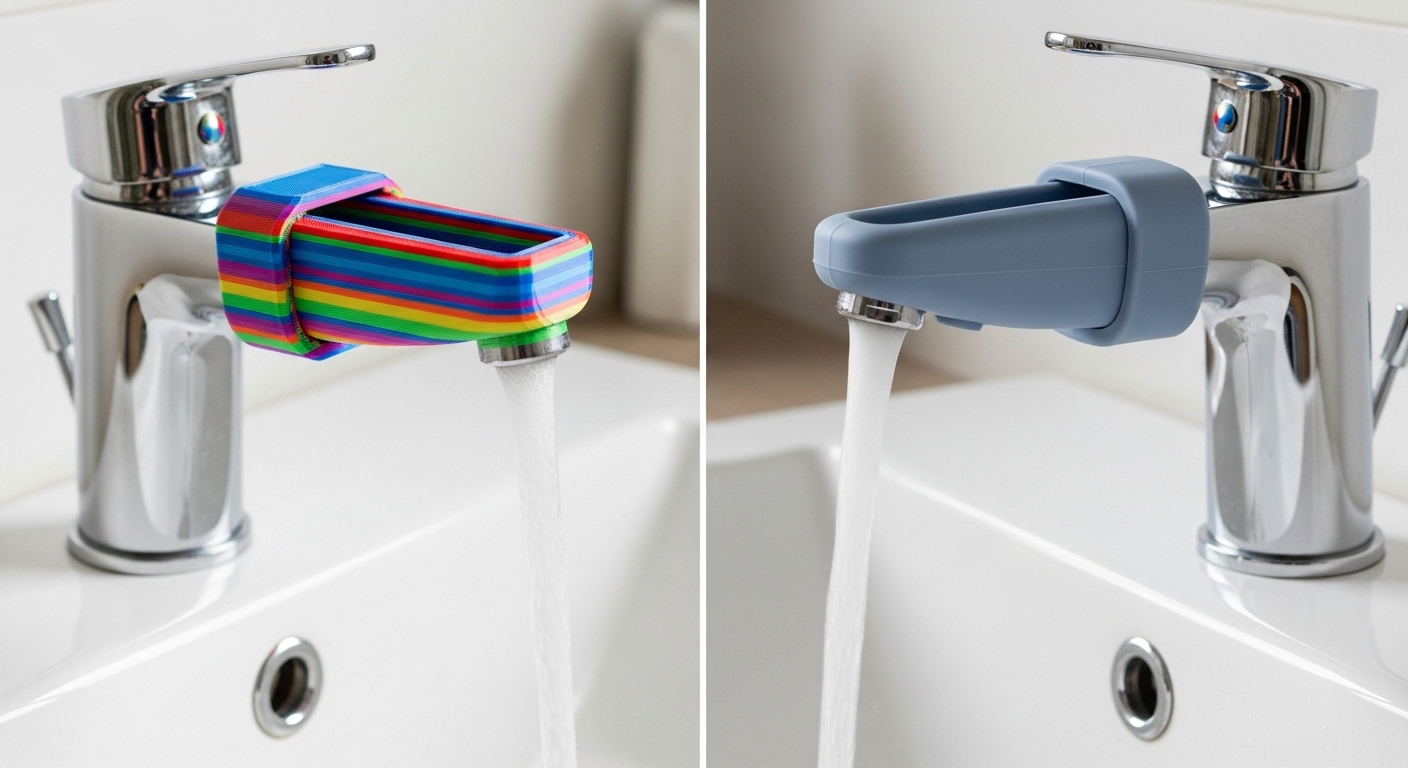
If you’ve been searching for a faucet extender stl file, you’re almost certainly trying to solve one specific problem: a small child (or someone with limited reach) can’t get their hands under the tap without climbing or stretching, and you’ve seen those cute “froggy” or “duck” spouts online. Downloading a printable model feels like the cheap, clever fix. It can be — but there are real trade-offs around hygiene, water safety, and durability that the Thingiverse description never mentions. This guide walks through exactly when a printed STL makes sense, when it doesn’t, and what a properly engineered extender should actually do.
At wewefaucet, we design and stress-test faucet hardware for a living, so we’ll give you the honest engineering view rather than just “print it, it’s free.” By the end you’ll know which route fits your sink, your budget, and the person actually using it.
What exactly is a “faucet extender STL,” and what does it do?
A faucet extender STL is a digital 3D-model file (STL = “stereolithography,” the standard mesh format 3D printers read) that you slice and print at home or order through a print service. Once printed, the part clips or screws onto your existing spout and redirects the water stream forward and slightly down — typically extending the reach by 2 to 4 inches — so a child standing at the sink can wash their hands without leaning their whole body over the basin.
Functionally, it’s the printed cousin of the molded silicone “water spout extenders” you see in kids’ bathrooms. The job is simple: move the point where water exits the tap closer to the front edge of the sink. Where they differ enormously is in material quality, fit, and how cleanable they are over months of daily use.
- Reach extension: good extenders add 2–4 inches of forward reach without spraying past the basin.
- Grip/seal: a flexible lip wraps the aerator housing so it doesn’t shoot off under pressure.
- Flow control: the better ones keep the stream gentle rather than turning it into a high-pressure jet that splashes everywhere.
That last point connects to how your tap’s tip is engineered in the first place — the aerator. If you’ve never looked at why that little screen matters, our explainer on how faucet aerators reduce splash and waste is worth a two-minute read, because a good extender works with the aerator, not against it.
Is a 3D-printed faucet extender actually safe for kids to use daily?
Honestly? With most common home setups, not really — and here’s the blunt reason. The two materials hobbyists print most often, PLA and PETG, are not the problem on their own; the problem is the printing process. FDM (filament) printing builds parts in microscopic layers, and those layer lines create thousands of tiny grooves and gaps. On a part that’s constantly wet, warm, and touched by little hands, those grooves become a near-perfect home for biofilm and mold. You physically cannot scrub them clean.
On top of that, standard PLA is not certified food- or water-contact safe. The raw resin might be, but cheap filaments contain colorants and additives that aren’t, and the brass nozzles on many printers can leave trace lead in the print. For a part that touches water your child then puts their hands in (and let’s be real, sometimes their mouth), that matters. If water safety is on your mind at all, it’s the same logic we lay out in our guide to how to identify lead-free bathroom faucets — certification, not assumption.
So a printed faucet extender stl can be genuinely useful for a guest bathroom used twice a month, a quick photo prop, or a temporary fix while a real one ships. For the main sink a toddler uses three times a day? The hygiene math doesn’t favor it.
Will the STL even fit my faucet? (The part nobody warns you about)
This is the hidden trap: most faucet extender STL files are modeled to fit one specific spout the designer owned, and faucet tips are not standardized in shape. The threaded part — the aerator housing — does follow rough size conventions (the common ones are 15/16″–27 male and 55/64″–27 female), but the outer shape your printed clip grips onto varies wildly between brands and finishes.
If your faucet has a square spout, a pull-down sprayer head, or an unusually large decorative tip, a generic clip-on STL often won’t seal. It’ll either fall off under water pressure or leak from the sides. Threaded designs are more reliable than clip-on ones because they engage the actual aerator threads — and if you want to understand how those threads are sized and why brass holds them better, our piece on what a brass faucet with thread is and how to choose one covers the standard sizing that makes or breaks any extender’s fit.
Before you spend an evening printing, measure your aerator’s thread (or unscrew it and read the spec on the side). A part that doesn’t fit is wasted filament, and a part that almost fits is a slow leak waiting to warp your vanity.
3D-printed STL vs. store-bought extender vs. upgrading the faucet: which should I pick?
Short answer: print only for a temporary or rarely-used sink; buy a molded silicone extender for a daily kids’ bathroom; and if your faucet is already old or short-reaching, consider replacing the whole tap. Here’s the honest comparison.
| Option | Typical cost | Hygiene / safety | Durability | Best for |
|---|---|---|---|---|
| 3D-printed STL (PLA/PETG) | $0–$3 in filament | Poor — porous layers trap biofilm; rarely food-safe certified | Weeks to a few months; cracks at clip | Temporary fix, low-use sink, prototyping |
| Molded silicone extender | $8–$15 | Good — smooth, dishwasher-safe, food-grade silicone | 1–3 years of daily use | Kids’ main bathroom, daily handwashing |
| Brass/metal threaded extender | $12–$25 | Excellent — non-porous, easy to sanitize | Many years; reusable across faucets | Adults wanting reach, deep sinks, long term |
| New longer-reach faucet | $60–$250+ | Excellent — engineered & certified as a unit | 5–15 years (warranty-backed) | Old/short faucet that’s also worn out |
Notice the pattern: the “free” option is only free if your time, a failed print, and the cleaning hassle are worth nothing. For most families, a $10 molded extender is the sweet spot. But if your tap is already dripping, low-flow, or just too short for a deep modern basin, sinking money into an add-on is patching a deeper issue — at that point a new faucet is the smarter spend.
How do I install a faucet extender so it doesn’t leak or fly off?
Whether printed or store-bought, installation is quick — under five minutes with no tools for clip-on types, or a pair of pliers for threaded ones. The goal is a tight seal with no side-spray. Follow these steps:
- Clean the spout tip. Wipe off grease and limescale so the extender’s lip can grip a smooth surface. (Mineral buildup is the #1 reason clips slip.)
- Identify your attachment type. Clip-on extenders push over the aerator housing; threaded ones screw on in place of — or below — the existing aerator.
- For threaded models, remove the old aerator by turning counter-clockwise (use a cloth so pliers don’t scratch the finish), then thread the extender on hand-tight plus a quarter turn.
- Run the water at low pressure first. Check for leaks at the seam. A little side-weep means the seal isn’t seated or the thread size is wrong.
- Dial in the angle. Aim the stream to land in the center-front of the basin, not the back wall and not over the front edge.
- Test the grip. Turn pressure to full briefly. If a clip-on extender shifts, it’s the wrong fit — don’t trust it around a child.
One overlooked detail: adding an extender changes how your stream behaves, which can increase splashing if your faucet runs at a high flow rate. If your tap sprays hard, it may be worth checking your flow — our breakdown of what GPM means in faucets explains how to tell whether a simple aerator swap would calm the stream better than any extender.
When is it smarter to skip the extender and replace the faucet entirely?
Replace the faucet instead of extending it when the tap is already showing its age — drips, mineral crust, a loose base, or a spout so short that even a 4-inch extender wouldn’t comfortably reach the basin. An extender is a band-aid; it can’t fix a worn cartridge, a corroded body, or a faucet that was simply too small for the sink to begin with.
A few clear signals it’s replacement time rather than extender time:
- The faucet drips or the handle feels gritty (worn internals an add-on won’t help).
- You see rust or discoloration in the water — a deeper corrosion issue, not a reach issue.
- The spout is fixed and so short that water hits the back of the basin.
- You’re already planning a bathroom refresh and the tap looks dated.
A modern pull-down or longer gooseneck faucet solves the reach problem at the source, comes certified as a complete unit, and is backed by a warranty no STL file can offer. If you’re weighing that route, it’s worth understanding the fine print first — our guide to understanding faucet warranty terms explains what’s actually covered before you buy.
What makes a good faucet extender, printed or bought?
The best extender is the one that seals tightly, stays clean, and keeps the stream gentle. Whatever route you choose, judge it on these four things:
- Material safety: food-grade silicone or lead-free brass/stainless, not raw hobby filament. Look for NSF/ANSI or equivalent certification if it touches drinking water.
- Smooth, cleanable surfaces: non-porous so biofilm can’t take hold. This is exactly where printed parts lose.
- Secure, correct-size fit: threaded beats clip-on; match your aerator size.
- Controlled flow: it should soften the stream, not turn it into a splash cannon.
If you do decide to print one anyway — say, for a low-use sink or as a quick prototype — at least use a certified food-safe filament, print at high infill with fine layer height, and seal the surface with a food-safe coating. Treat it as temporary and replace it the moment you see discoloration. That’s the responsible way to use a faucet extender stl without gambling on your family’s hygiene.
FAQ
Is PLA safe for a faucet extender that touches water?
Not reliably. While some pure PLA resins are technically food-contact safe, most consumer filaments contain colorants and additives that aren’t certified, and the porous, layered surface of an FDM print traps bacteria and mold that you can’t scrub out. For occasional, low-use sinks it’s a tolerable temporary fix; for a child’s daily-use bathroom, a smooth molded silicone or lead-free metal extender is the safer call.
Will a generic faucet extender STL fit any faucet?
No. Faucet spout shapes aren’t standardized, so a clip-on STL modeled for one tap often won’t seal on another, especially square spouts, pull-down sprayers, or oversized decorative tips. Threaded designs are more universal because they engage standard aerator threads (commonly 15/16″–27 or 55/64″–27) — measure or unscrew your aerator before printing or buying.
How much does a real faucet extender cost compared to printing one?
A 3D print costs roughly $0–$3 in filament but adds your time, a likely failed attempt, and ongoing cleaning hassle. A molded silicone extender runs about $8–$15 and lasts 1–3 years; a brass or stainless threaded extender is $12–$25 and lasts for years across multiple faucets. For most households the store-bought option is the better value once durability and hygiene are counted.
Do faucet extenders increase splashing?
They can, if your faucet runs at a high flow rate, because the extended stream hits the basin at a different angle. The fix is usually a lower-flow aerator or a gentler extender design that softens the stream. If splash is your main complaint, swapping the aerator may solve it more cleanly than adding an extender at all.
Can I just buy a longer faucet instead of using an extender?
Yes, and it’s often the smarter long-term move — especially if your current tap is old, dripping, corroded, or simply too short for a deep sink. A new longer-reach or pull-down faucet solves the reach problem at the source, arrives certified as a complete unit, and carries a warranty. An extender is best when your faucet is otherwise in great shape and you only need a few extra inches of reach.
Author note: This guide was written by the wewefaucet product team, who design, source, and bench-test faucet hardware and accessories for residential bathrooms and kitchens. Our recommendations are based on hands-on fit-and-flow testing against common North American aerator standards, materials certified to lead-free (NSF/ANSI 372) requirements, and warranty-backed durability — not just spec sheets. When we say a printed part fails sooner than a molded one, it’s because we’ve watched it happen in testing. wewefaucet has spent years helping homeowners pick fixtures that are safe, durable, and right-sized for the way they actually live.
您好!please sign in