 WEWE Kitchen Faucets
How Do You Measure Faucet Supply Line Size the Right Way So It Actually Fits?
Views:171 classificationInstall
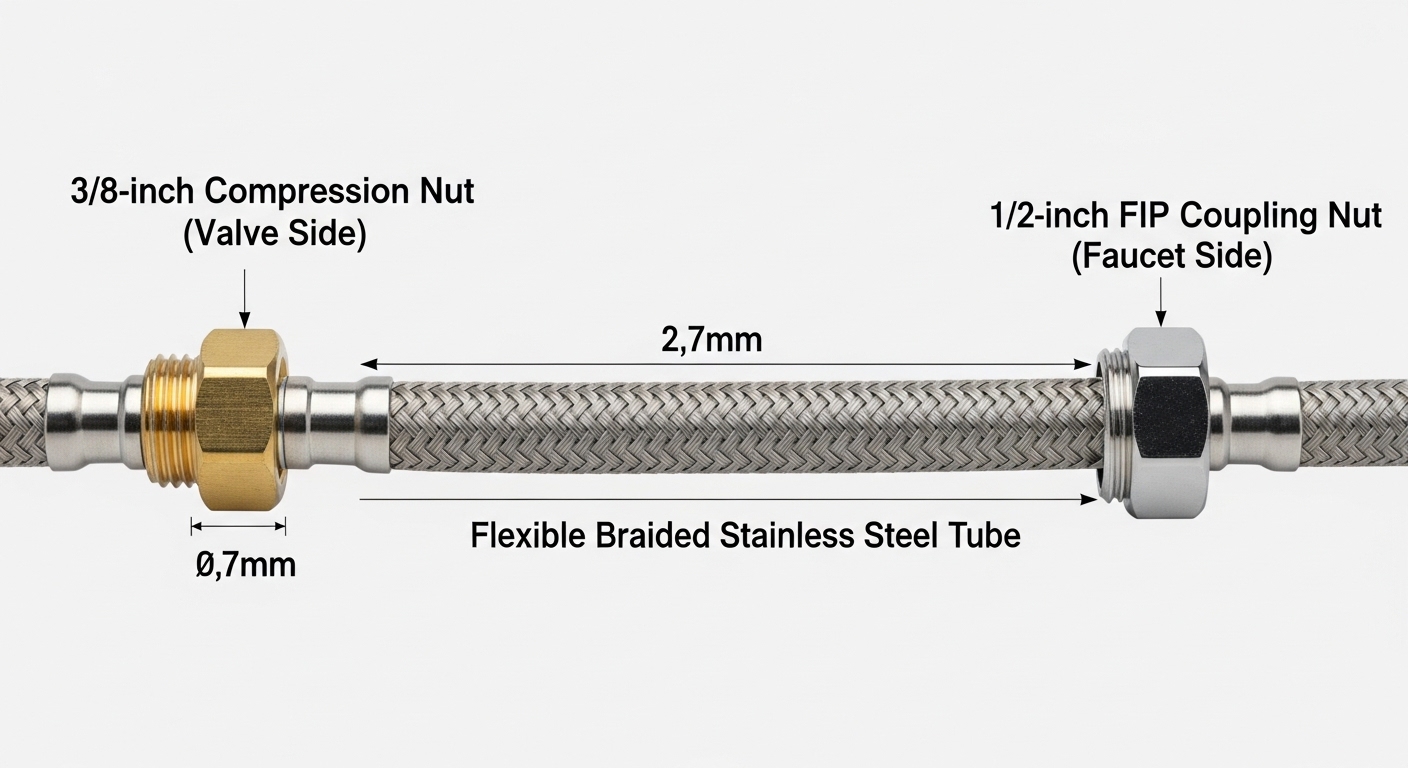
Learning how to measure faucet supply line size is the one step that separates a 15-minute faucet install from three frustrating trips to the hardware store. The problem is that “supply line size” actually means two different measurements — the fitting/thread size on each end, and the overall length — and the numbers printed on the packaging (like “3/8″ x 1/2″”) describe the connectors, not the hose diameter. Get those confused and you end up with a line that either won’t thread on or is six inches too short. This guide walks you through exactly what to measure, how to read the markings, and which sizes fit which faucets, so you buy the right line the first time.
What Does “Faucet Supply Line Size” Actually Mean?
Faucet supply line size refers to two things at once: the connection size on each end (the threaded fittings that join the line to your shut-off valve and to your faucet tailpiece) and the length of the flexible tube between them. It almost never refers to the physical diameter of the braided hose itself. That’s the single most common point of confusion, so let’s untangle it.
A supply line has two ends, and each end can be a different size. A typical bathroom faucet line is labeled 3/8″ x 1/2″, which means one end has a 3/8″ compression connector (for the angle stop valve) and the other end has a 1/2″ female connector (for the faucet’s 1/2″-14 male tailpiece). Kitchen faucets and toilets have their own common pairings. So when someone asks what size supply line they need, the honest answer is: it depends on what’s on the wall and what’s under the faucet — you have to measure both.
- Valve-side connection: what threads onto your shut-off valve (angle stop). Usually 3/8″ compression or 1/2″ compression.
- Faucet-side connection: what threads onto the faucet’s tailpiece or connector. Common options are 1/2″ FIP, 3/8″ compression, 7/16″ or 1/2″ ballcock, or a manufacturer-specific quick-connect.
- Length: the tube length, measured with a little slack so the line curves gently instead of pulling straight and tight.
How Do You Measure the Connection Size on Each End?
The reliable way to measure a supply line connection is to identify the fitting type first, then measure the thread’s outside diameter for male threads or inside diameter for female threads with a caliper or a thread gauge — but for 90% of home faucets, you can skip the tools and just read the stamp on your existing line. Here’s the practical order of operations.
Step 1: Read the markings on your old line
Most supply lines have the size printed or embossed right on the coupling nut or the crimp collar — something like “3/8 C” (3/8″ compression) or “1/2 FIP.” If your old line is legible, you’re done: buy the same thing. Manufacturers make you do the hard work only when the line is unmarked or you’re installing from scratch.
Step 2: Identify the fitting type by look
Before you measure a number, name the fitting. The three you’ll meet under a residential sink are:
- Compression: a smooth (unthreaded) tube slides into the valve, and a nut squeezes a brass ferrule to seal. The nut itself is threaded. This is what’s on almost every angle stop under a modern American sink.
- FIP / male pipe thread (tapered NPT): tapered threads that get tighter as they go in, sealed with PTFE tape. You’ll see this on some faucet tailpieces and older plumbing.
- Ballcock / faucet-specific: straight-thread couplers sized to a faucet’s own shank, common on toilets (7/16″ and 1/2″) and some faucets.
Step 3: Measure the diameter
For a compression fitting, measure the outside diameter (OD) of the smooth tube the nut goes over — 3/8″ OD is standard for faucets, 1/2″ OD is common for some valves and refrigerators. For a threaded end, measure across the threads: a 1/2″ FIP faucet connector measures roughly 13/16″ across the outside of its male mate (the “1/2” is the nominal pipe size, not the physical width — pipe sizing is famously counterintuitive). When in doubt, take the old part to the store and match it physically.
A quick note on why “3/8″ isn’t really 3/8”
Plumbing thread sizes are “nominal,” meaning the label is a name, not a literal measurement. A 3/8″ compression tube really is about 0.375″ on the outside, but a “3/8″ pipe thread” (like on a gas line) is wider than that. For faucet supply lines you’re almost always dealing with compression tube OD, so 3/8″ on the label does match a ~3/8″ tube. Just don’t try to reconcile it with a tape measure across a threaded fitting — that way lies madness. If you want the deeper mechanics of thread standards, our guide on what a brass faucet with thread is and how to choose one breaks down NPT, BSP, and compression threading in plain language.
What Supply Line Size Does a Standard Bathroom or Kitchen Faucet Need?
For the vast majority of residential faucets in North America, you need a 3/8″ compression connection on the valve end, and a 1/2″ FIP (or 3/8″ compression) connection on the faucet end, in a length of 12–20 inches. That single sentence covers most bathroom lavatory and kitchen faucets sold today. The differences come down to the faucet-side connector and the length.
Here’s how the common pairings shake out by fixture:
| Fixture | Valve-side connection | Faucet-side connection | Typical length |
|---|---|---|---|
| Bathroom lavatory faucet | 3/8″ compression | 1/2″ FIP or 3/8″ compression | 12″–20″ |
| Kitchen faucet (standard) | 3/8″ compression | 1/2″ FIP or 3/8″ compression | 20″–30″ |
| Kitchen faucet (pull-down, pre-attached hoses) | 3/8″ compression | Pre-installed 3/8″ or brand quick-connect | 20″–36″ |
| Toilet | 3/8″ or 1/2″ compression | 7/16″ or 1/2″ ballcock | 9″–20″ |
| Refrigerator / ice maker | 1/4″ compression | 1/4″ compression | Varies |
Kitchen faucets deserve special attention because many modern pull-down and pull-out models ship with the supply hoses permanently attached to the faucet body. In that case you don’t choose the faucet-side connector at all — you only need to match the free ends to your shut-off valves, which are almost always 3/8″ compression. If you’re still selecting the faucet itself, our real buyer’s guide to what size faucet a kitchen sink needs covers spout height, reach, and hole spacing so the whole thing fits together.
How Long Should the Supply Line Be, and How Do You Measure Length?
Measure from the outlet of your shut-off valve to the faucet’s inlet along the natural path the line will travel, then add 2–4 inches of slack and round up to the nearest available stock length (12″, 16″, 20″, 24″, 30″). A supply line should never be pulled bar-tight — tension stresses the fittings and invites leaks — but it also shouldn’t be so long that it kinks or coils against the cabinet floor.
Here’s a clean way to get the number:
- Shut off the water and open the faucet to drain pressure.
- Hold the end of a soft tape measure at the valve outlet where the line will connect.
- Route the tape up to the faucet inlet the way the line will actually run — usually a gentle curve, not a straight vertical line.
- Read the length, then add roughly 3 inches so the finished line makes a relaxed loop.
- Round up to the next stock size. It’s always better to have a line slightly long (it curves) than slightly short (it strains).
Braided stainless steel lines are forgiving here because they flex easily, which is why they’ve largely replaced the old rigid chrome and plastic risers. If you’re roughing in new plumbing rather than swapping a faucet, the valve height off the floor determines a lot of this — our detailed walkthrough on bathroom sink supply line height and rough-in gives the standard measurements (typically 19″–23″ for the valves) so your finished lines land at a comfortable, leak-free length.
Braided Stainless vs. Other Supply Line Materials — Does It Change the Size You Buy?
The material doesn’t change the connection sizes you measure — a 3/8″ compression fitting is 3/8″ whether the tube is braided steel, PVC, or vinyl — but it absolutely changes durability, and that’s worth 30 seconds of thought before you buy. Braided stainless steel over an EPDM or PEX core is the modern default for good reason.
| Line type | Connection sizing | Best for | Lifespan / notes |
|---|---|---|---|
| Braided stainless steel | Standard 3/8″, 1/2″, 1/4″ fittings | Almost every faucet install | Flexible, burst-resistant, ~8–10 yr; the safe default |
| Braided PEX/nylon | Same standard fittings | Budget installs, tight spaces | Cheaper, flexible; slightly shorter service life |
| Rigid chrome-plated copper riser | Cut/bent to length, compression ends | Exposed, visible installs (pedestal sinks) | Looks clean but must be bent precisely; unforgiving of length errors |
| Vinyl / plastic (older) | Standard fittings | Legacy replacements only | Cheapest, most failure-prone; upgrade when you can |
My general advice: buy braided stainless in the correct connection size and a length that gives you gentle slack, and don’t overthink the rest. The few extra dollars over vinyl buys real burst protection under a cabinet you rarely check.
What Are the Most Common Mistakes When Measuring Supply Line Size?
The number-one mistake is confusing the hose diameter with the connection size — buying a “3/8″” line thinking it means the tube, when 3/8″ refers to the compression fitting. Below are the errors I see trip up DIYers most often, and how to dodge each one.
- Assuming both ends are the same size. Many lines are 3/8″ x 1/2″. Read (or measure) each end separately.
- Measuring across threads for a nominal size. A tape measure across a “1/2″ FIP” fitting won’t read 0.5″. Match the fitting type and name, don’t chase the literal width.
- Buying too short. A tight line strains the compression seal and can weep for years. Add slack and round up.
- Ignoring a quick-connect faucet. Some brands (many pull-down kitchen faucets) use proprietary quick-connect couplers. If yours does, you may need an adapter rather than a standard threaded line — see our guide on the right faucet sprayer quick-connect adapter for pull-down kitchen faucets.
- Over-tightening. Compression and FIP connections seal with a firm hand-tight plus a quarter to half turn with a wrench — cranking harder cracks ferrules and strips threads.
Which Tools Do You Actually Need to Measure and Install?
You need almost nothing: a tape measure, an adjustable wrench, and ideally your old supply line to match against. Calipers help if you’re measuring an unmarked fitting, but they’re optional. Here’s the honest minimum kit.
- Soft tape measure — for length along the real path.
- Adjustable wrench or basin wrench — to snug the coupling nuts.
- Digital calipers (optional) — only if a fitting is unmarked and you want an exact OD.
- PTFE (plumber’s) tape — for FIP/tapered threads only, never for compression seals.
- Your old line — the single best “measuring tool” you own; match it at the store.
One more model-specific tip: if you own a common branded faucet, someone has usually already documented its exact line size. For example, our reference on the supply line size a Moen Banbury faucet needs spells out the exact connectors so you can buy without measuring at all — worth checking if your faucet is a mainstream model.
Author Note, Credibility & Standards
This guide was written by the WeWe Faucet product team, drawing on hands-on installation of thousands of residential faucets and years of fielding “what size line do I need?” questions from real customers. At wewefaucet (www.wewefaucet.net), we manufacture and test kitchen and bathroom fixtures to standard North American connection specs, and our faucets ship with the tailpiece thread sizes clearly documented so you can size your supply lines with confidence.
On standards and safety: reputable supply lines and faucet connectors are certified to ASME A112.18.1 / CSA B125.1 and lead-free requirements under NSF/ANSI 372. When you buy a line, look for these markings — they confirm the fitting dimensions are true to spec and the materials are potable-water safe. We back our faucets with a limited lifetime warranty on the finish and function of the fixture itself; note that flexible supply lines are wear items and should be inspected periodically and replaced roughly every 5–8 years regardless of brand.
FAQ
Is a faucet supply line 3/8 or 1/2 inch?
Most residential faucet supply lines use a 3/8″ compression connection at the shut-off valve and a 1/2″ FIP connection at the faucet — that’s why they’re often labeled “3/8″ x 1/2″.” The 3/8″ refers to the compression tube going onto the valve, and the 1/2″ refers to the faucet-side threaded coupling. Always confirm both ends, because the pairing can vary.
How do I know what size supply line to buy without measuring?
Read the size stamped on your existing supply line’s nut or collar (like “3/8 C” or “1/2 FIP”) and buy the same thing, or bring the old line to the store and physically match it. For a brand-new install, 3/8″ compression at the valve and 1/2″ FIP at the faucet, in a 16″–20″ length, covers most bathroom and kitchen faucets.
What size is a standard kitchen faucet supply line?
A standard kitchen faucet uses 3/8″ compression connectors at the wall valves, with a faucet-side connection that’s either 1/2″ FIP or, on many modern pull-down models, hoses permanently pre-attached to the faucet body. Kitchen lines usually run longer than bathroom lines — 20″ to 30″ — because the valves sit farther from the faucet inlets.
Can I use a supply line that’s too long?
A slightly long line is fine and actually preferred over a short one — it simply forms a gentle loop under the sink. Avoid excessively long lines that coil, kink, or press against the cabinet, since kinks restrict flow and stress the tube. When in doubt, round up to the next stock length and let the extra become a relaxed curve.
Do I need plumber’s tape on a supply line connection?
Use PTFE plumber’s tape only on tapered pipe threads (FIP/NPT), never on compression fittings or on the rubber-gasketed coupling nuts most braided lines use — those seal with a gasket or ferrule and adding tape can prevent a proper seal. For a standard braided line with a captured washer, hand-tighten plus a quarter turn with a wrench and you’re done.
How often should I replace a faucet supply line?
Inspect flexible supply lines every year or two and replace them roughly every 5–8 years, sooner if you see corrosion, bulging, rust spots on braided steel, or any weeping at the fittings. A burst supply line is a leading cause of household water damage, so replacing an aging braided line during any faucet swap is cheap insurance.
您好!please sign in