 WEWE Kitchen Faucets
What Supply Line Size Does a Moen Banbury Faucet Actually Need?
Views:161 classificationInstall
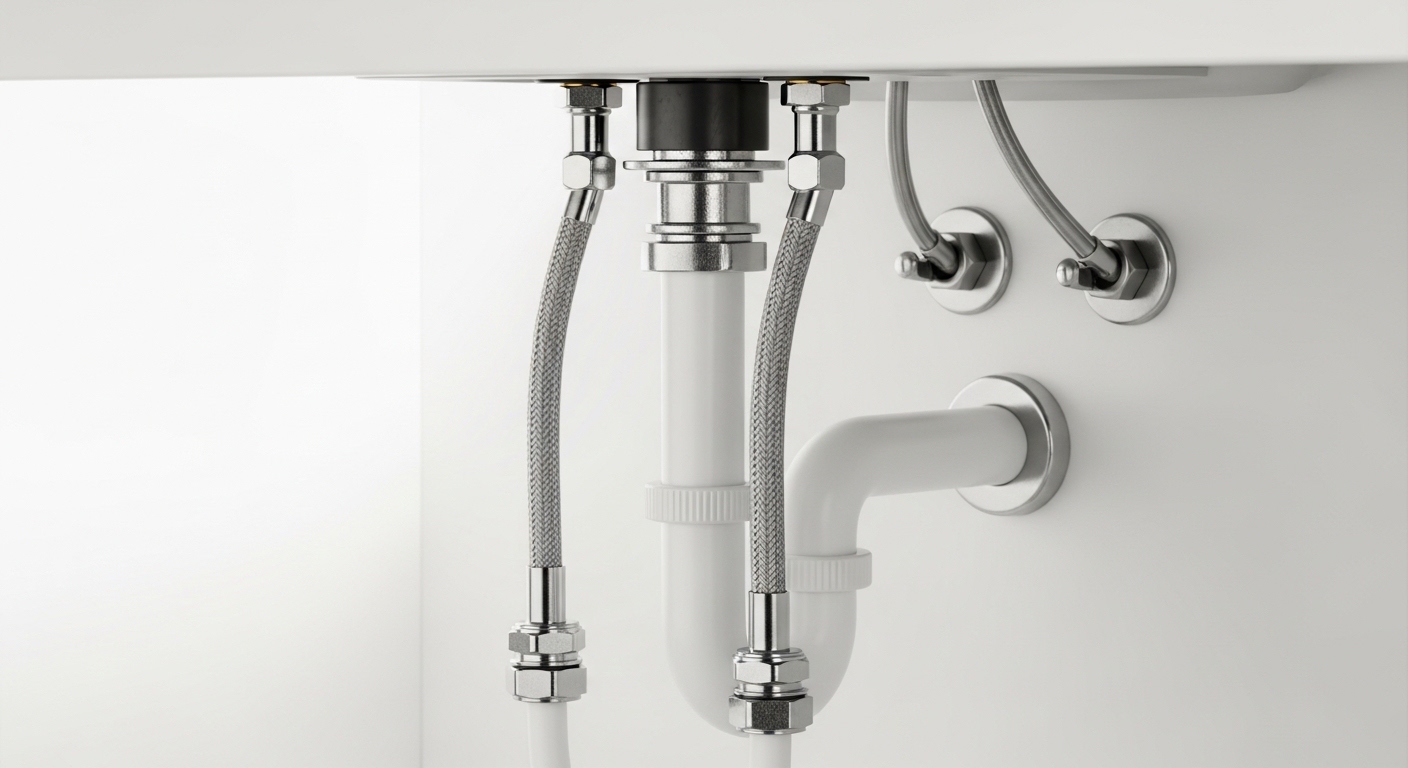
If you’re standing at the hardware store trying to figure out the moen banbury faucet supply line size, here’s the short version: the faucet-side connection is almost always 3/8" compression, and your under-sink shutoff valve almost certainly puts out 3/8" compression too. That means a standard 3/8" comp × 3/8" comp braided stainless supply line is the part you’re looking for — no adapters, no guesswork. Below we’ll break down exactly why that is, the one or two situations where it’s different (like a 1/2" FIP valve or a pre-attached line), and how to pick the right length so you’re not fighting a kinked hose in a cramped cabinet.
This matters because supply-line mismatches are the single most common reason a “15-minute” faucet swap turns into three trips to the store. Get the size right the first time and the actual install is genuinely easy.
What size supply line does a Moen Banbury bathroom faucet use?
A Moen Banbury bathroom (lavatory) faucet uses a 3/8" compression connection, and on most centerset and single-handle Banbury models the flexible supply lines come pre-attached from the factory. That’s the part people miss: you often don’t buy the faucet-side line at all — it’s already hanging off the faucet body, ending in a 3/8" compression female thread that threads straight onto a standard angle stop.
The Banbury bath line (single-handle models like the 84165 series and the centerset two-handle versions) is built as a value fixture, so Moen keeps the plumbing standard and predictable. Here’s what you’re dealing with underneath:
- Connection type: 3/8" compression, female, at the end of the pre-attached braided line.
- Line material: braided stainless steel over PEX/EPDM core — flexible, no kinking like old poly risers.
- Typical length: the factory lines run roughly 18–20 inches, long enough for most standard vanities.
- What you actually connect to: your under-sink shutoff (angle stop), which on nearly all modern US installs terminates in a 3/8" compression outlet.
So for a bathroom Banbury, the honest answer to “what supply line do I need?” is often none — just a pair of 3/8" compression connections onto your valves. You only buy new lines if the factory ones are too short to reach your shutoffs, or if you’re replacing a damaged line. Because the Banbury is a centerset-style faucet, the connections sit close together under the sink; if you’re not sure whether your sink layout is centerset, our guide on what a centerset faucet is walks through the hole spacing so you can confirm before you buy.
What about the Moen Banbury kitchen faucet — is it the same size?
Yes, functionally the same: the Moen Banbury kitchen faucet also uses a 3/8" compression connection, but the setup underneath is slightly different because kitchen faucets carry more water and often have a pull-down sprayer. On kitchen Banbury models (such as the 87017 and similar single-handle pull-down versions), the faucet has a threaded shank or a pre-installed line that terminates in a 3/8" compression female fitting.
The key difference from the bathroom version isn’t the size — it’s the flow. Kitchen supply lines should have a wider inner diameter so you don’t choke the flow rate on a faucet that’s designed to fill pots quickly. When you buy a replacement, look for a line labeled specifically as a “faucet supply line” with 3/8" compression ends, not a low-flow toilet line (toilet lines are also 3/8" comp on one end but have a narrower bore and a different 7/8" ballcock nut on the other end — wrong part entirely).
For kitchen Banbury installs, length matters more because the cabinet is deeper and the valves can sit farther back. A 20-inch line is the safe default; measure if your shutoffs are unusually low or far apart.
3/8" compression vs. 1/2" — how do I know which end I actually have?
Read the two ends separately: the faucet side on a Banbury is 3/8" compression, and the valve side depends on your shutoff, which is 3/8" compression on the vast majority of homes built or re-plumbed in the last few decades. The confusion almost always comes from mixing up thread type with pipe size, so let’s make it concrete.
“3/8" compression” describes the outside diameter of the tube the fitting is designed to seal onto — not the thread you can see. A 3/8" compression female nut looks like it’s about 5/8" across at the threads, which trips people up. Meanwhile “1/2" FIP” or “1/2" IPS” is a pipe-thread size you’ll sometimes see on the faucet shank itself or on older/tub-and-shower valves.
| Connection | Where you see it | How to identify it | Banbury match? |
|---|---|---|---|
| 3/8" compression (female) | Faucet-side line end & most angle stops | Smooth-bore nut, seals on tubing, ~5/8" across threads | Yes — standard for Banbury |
| 1/2" FIP / 1/2" IPS | Some faucet shanks, older valves | Tapered pipe thread, larger opening | Sometimes at the shank — use a 1/2" FIP × 3/8" comp line |
| 7/8" ballcock | Toilet tank fill valve | Big plastic nut | No — wrong part, toilet only |
| Push-fit / quick-connect | Some modern faucets & valves | No threads, pushes on | Rare on Banbury; verify before buying |
The practical takeaway: buy a supply line that is 3/8" compression on both ends and you’ll be right in probably 9 out of 10 homes. If your faucet shank is threaded 1/2" instead of having a pre-attached line, grab a 1/2" FIP × 3/8" compression line instead. If you want to understand how those shank threads are specified and why brass fittings behave the way they do, our explainer on the brass faucet with thread covers NPSM vs. NPT sizing in plain language.
What length supply line do I need for a Banbury under a standard sink?
For most installs, a 16" to 20" supply line is the sweet spot — long enough to reach the shutoff without stretching, short enough that it doesn’t coil up and kink behind the trap. The right length depends on the vertical distance from your faucet inlet down to the angle stop, plus a little slack.
Here’s how to measure it right the first time:
- Turn off the water at the angle stops and open the faucet to relieve pressure.
- Measure from the faucet inlet (or the bottom of the pre-attached line) down to the outlet of the shutoff valve.
- Add about 2–3 inches of slack so the line makes a gentle curve, not a tight bend. A sharp kink restricts flow and stresses the fitting.
- Round up to the nearest common length: 12", 16", 20", or 24".
Braided stainless lines are the modern standard for a reason — they flex to absorb small measurement errors, they don’t crack like old plastic risers, and they’re rated for the constant pressure a supply line lives under. If your rough-in plumbing sits at an awkward height and you’re not sure where the valves “should” be, our deep dive on bathroom sink supply line height shows the standard rough-in dimensions so you can plan the run cleanly.
How do I actually install the supply lines on a Moen Banbury?
Hand-tighten the compression nut, then give it about a quarter to half turn with a wrench — that’s it. Compression fittings seal by squeezing a small ferrule (or, on a flexible line, by an integrated washer), so they do not need to be cranked down hard. Over-tightening is the number-one cause of leaks and cracked nuts on a Banbury install.
Step by step:
- Shut off the water at both angle stops and open the faucet to drain pressure.
- Thread the faucet-side connection first (or confirm the pre-attached line is snug at the faucet).
- Hand-thread the valve-side nut onto the shutoff. Make sure it starts straight — cross-threading a compression nut ruins the seal.
- Snug with a wrench: hand-tight plus roughly 1/4–1/2 turn. Hold the valve body with a second wrench so you don’t twist the stop.
- Turn the water back on slowly and watch every joint for 60 seconds. Wipe each connection with a dry paper towel — the towel finds weeping leaks your eye misses.
- If it drips, tighten another 1/8 turn. Still dripping? Back it off, check the washer/ferrule, and re-seat. Don’t just keep cranking.
You don’t need thread tape on a compression connection — the seal is mechanical, not thread-based. (Save the PTFE tape for threaded pipe joints like a 1/2" FIP shank.) If you’d rather understand where DIY saves you money versus where a pro is worth it, we broke that math down in how to save money on faucet installation.
Which supply line should I buy for a Banbury — a quick comparison
Buy a braided stainless steel line with the correct end fittings; skip the cheap plastic risers. Here’s how the common options stack up so you can grab the right one without overthinking it.
| Supply line type | End fittings for Banbury | Best for | Lifespan / notes |
|---|---|---|---|
| Braided stainless steel | 3/8" comp × 3/8" comp (or 1/2" FIP × 3/8" comp) | Almost every Banbury install | Longest life, flexes, burst-resistant — the default |
| Braided PEX/poly | 3/8" comp × 3/8" comp | Budget swaps | Fine short-term; less abrasion-resistant than stainless |
| Rigid copper riser | Cut to length, 3/8" comp | Exact-fit, exposed runs | Clean look but unforgiving — no flex for measurement errors |
| Vinyl/plastic riser | 3/8" comp | Not recommended | Prone to cracking & kinking; skip it |
For a faucet in the Banbury’s value tier, a good braided stainless line costs only a couple dollars more than the plastic option and is far less likely to fail while you’re on vacation. It’s the definition of cheap insurance.
Why does supply line size get confused with the faucet’s water flow?
Because “3/8" compression” refers to the connection, not the water volume — and those are two different specs. The compression size tells you how the line seals onto the valve; the inner diameter and the faucet’s aerator determine actual flow (measured in gallons per minute). A Banbury bathroom faucet is typically rated around 1.2 GPM and a kitchen version around 1.5 GPM, and those numbers are set by the aerator, not the supply line.
So don’t buy an oversized line hoping for “more pressure” — on a residential faucet it won’t change anything you can feel, and the fitting still has to be 3/8" compression to mate with your valve. If you’re genuinely curious how flow ratings work and what actually affects the stream, that’s the whole subject of our piece on the topic, but for supply-line purposes: match the connection, use a full-bore braided line, and your Banbury will flow exactly as designed.
FAQ
Does the Moen Banbury faucet come with supply lines included?
Most Banbury bathroom faucets ship with flexible braided supply lines already attached to the faucet body, ending in a 3/8" compression female connector. Kitchen Banbury models may have a pre-installed line or a threaded shank — check the box contents. Either way, you connect to a standard 3/8" compression angle stop.
Is the Moen Banbury supply line 3/8 or 1/2 inch?
The connection is 3/8" compression on the faucet side for nearly all Banbury models. You’d only need a 1/2" FIP fitting if your specific faucet has a bare 1/2" threaded shank instead of a pre-attached line — in that case buy a 1/2" FIP × 3/8" compression line.
What connects to the other end of the Banbury supply line?
Your under-sink shutoff valve (the “angle stop”). On the vast majority of modern US homes, that valve outputs a 3/8" compression connection, so a 3/8" comp × 3/8" comp line connects both ends with no adapter. Older homes occasionally have a 1/2" outlet, so check your valve before buying.
How long should the supply line be for a Banbury faucet?
Measure from the faucet inlet down to the shutoff valve outlet and add 2–3 inches of slack. Most bathroom vanities need a 16–20 inch line; deeper kitchen cabinets may need 20–24 inches. Buy slightly long rather than short — a gentle curve is fine, a stretched line is not.
Do I need plumber’s tape on the supply line connections?
No. Compression fittings seal mechanically with a ferrule or built-in washer, so thread tape does nothing there and can actually interfere. Just hand-tighten plus about a quarter turn with a wrench. Only use PTFE tape on true pipe threads, like a 1/2" FIP faucet shank.
Will a bigger supply line increase my Banbury’s water pressure?
No. Flow on a residential faucet is limited by the aerator and the faucet’s GPM rating, not the supply line. As long as you use a standard full-bore 3/8" braided line, upsizing won’t give you noticeably more pressure — and the fitting still has to match your 3/8" valve anyway.
The bottom line before you buy
For a Moen Banbury — bathroom or kitchen — the answer to the supply-line question is refreshingly consistent: 3/8" compression on the faucet side, 3/8" compression on the valve side, braided stainless, 16–20 inches long. Bathroom models often arrive with the lines already attached, so you may only need to confirm your angle stops are 3/8" compression (they almost always are). Buy the braided line, hand-tighten plus a quarter turn, and check for leaks before you walk away.
One last practical note: before you finish, hold onto your paperwork. Moen backs the Banbury line with a limited lifetime warranty on the faucet against leaks and finish defects, and using the correct, properly-installed supply connections keeps that coverage clean. If you want to know exactly what those terms cover, it’s worth reading up on understanding faucet warranty terms so a future leak is the manufacturer’s problem, not yours.
Author note: This guide was written and fact-checked by the wewefaucet fixtures team, drawing on hands-on installs of Moen and comparable value-tier faucets. At wewefaucet (www.wewefaucet.net) we source and test faucets and supply components for real-world durability, and we cross-reference connection specs against standard US plumbing practice — 3/8" compression angle stops, ASME/CSA-style flow ratings, and braided lines built to hold constant line pressure. When a spec varies by model, we tell you how to verify it on your own faucet rather than guess. Always confirm the fittings on your specific unit and follow the manufacturer’s installation sheet to preserve your warranty.
您好!please sign in