 WEWE Kitchen Faucets
What’s the Right Faucet Sprayer Quick Connect Adapter for My Pull-Down Kitchen Faucet in 2026?
Views:3157 classificationProduct
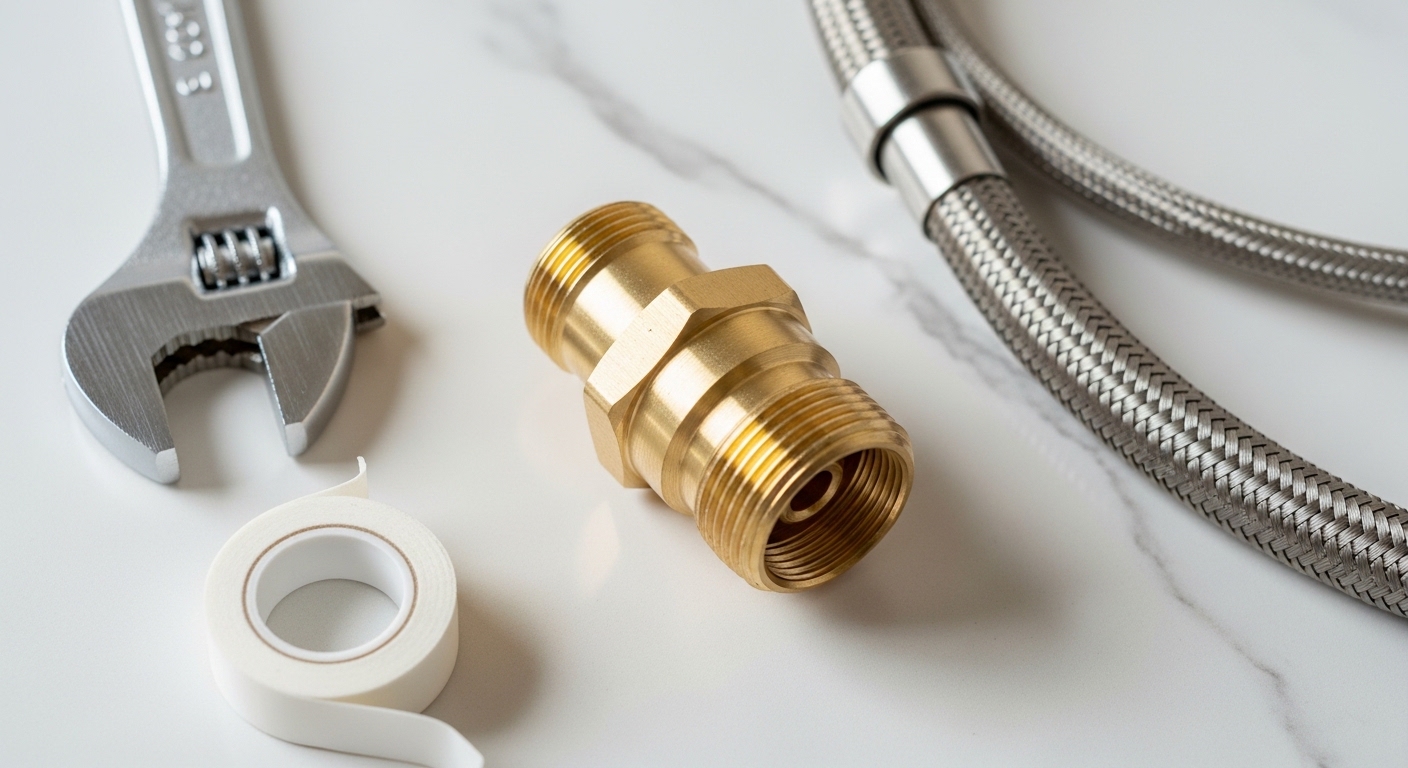
If your spray wand keeps popping off the hose under the sink, or you just replaced a spray head and discovered the connector doesn’t match anything at the hardware store, you’re in the right place. A faucet sprayer quick connect adapter is the small brass or plastic coupling that joins your flexible sprayer hose to either the spray wand at the top or the faucet body at the bottom — and choosing the wrong one is the single most common reason DIY faucet repairs leak. This guide walks through how to identify the adapter you actually need, which sizes and thread standards exist, what to buy for commercial-grade reliability, and how to install it without a callback to the plumber.
What exactly is a faucet sprayer quick connect adapter, and where does it sit on my faucet?
A faucet sprayer quick connect adapter is a small two-piece coupling — a male barb or threaded stem on one side and a spring-loaded female collar on the other — that lets you join or separate the sprayer hose without tools. On a pull-down or pull-out kitchen faucet it usually lives in one of two places: between the spray wand and the flexible hose (so you can swap the wand without crawling under the sink), or between the hose and the faucet body inlet at the bottom of the spout column. On older side-sprayer setups (a separate spray button next to the spout), the adapter typically threads into the faucet’s diverter or directly onto a 1/2" or 3/8" brass nipple under the deck.
The whole point of the “quick connect” is that you push the male end into the female collar, hear a click, and the internal spring clip locks it. To release, you push the collar inward and pull. No threads to cross, no tape, no wrench — in theory. In practice, mismatched ODs and worn O-rings cause most of the leaks people blame on the faucet itself.
How do I know which faucet sprayer quick connect adapter actually fits my faucet?
Identify three things before you buy anything: the thread standard at the wand or faucet body, the outer diameter of the hose, and the connector style your brand uses. That’s the whole job. Get those three right and any reputable adapter will work; get one wrong and you’ll be back at the store.
Here’s the short checklist most professional installers run through:
- Thread standard: Most US kitchen faucets use 1/2"-14 NPSM (straight thread) at the spray-wand junction. European and many import brands use G1/2" (BSP), which looks identical but has a slightly different pitch — forcing one into the other cracks the brass.
- Hose outer diameter (OD): Pull-down hoses are almost always 9 mm or 10 mm OD. Side-sprayer hoses (the thin vinyl kind) are usually 3/8" OD. Measure with calipers if you can; a tape measure across the braid is close enough.
- Connector style: Push-fit collar (the Moen/Delta/Kohler style), bayonet quarter-turn (some Pfister and Grohe models), or threaded compression nut (older two-handle faucets and most commercial pre-rinse units).
- O-ring material: EPDM for general potable water, Viton if you have very hot water or chloraminated municipal supply.
- Body material: Solid brass or 304 stainless for any faucet you plan to keep more than five years; ABS plastic is fine for a budget patch but degrades under hot, hard water.
If you’re unsure which thread standard you have, pull the spray wand off and take it — not a photo of it — to a plumbing supply house. A real counter tech will identify it in ten seconds. If you’re shopping online, look at the OEM part number on the underside of the wand or in the faucet’s installation manual; most major brands publish their adapter specs.
Why does my pull-down sprayer keep disconnecting — is the adapter to blame?
Nine times out of ten, yes. A pull-down spray head that falls off mid-rinse almost always traces back to one of three things: a worn O-ring inside the female collar, a hose OD that’s slightly under-sized for the adapter (common when you mix a third-party hose with an OEM coupler), or a magnetic dock that’s pulling the wand back so hard it stresses the connection over time. Replace the adapter and the O-ring as a set and the problem typically disappears.
If you’ve already swapped the O-ring and it still slips, check the spring clip inside the collar with a flashlight. Mineral scale from hard water can hold the clip open just enough to lose the lock. A quick soak in white vinegar for 30 minutes usually restores it. For homes with very hard water, this is worth doing yearly — the same way you’d descale a faucet aerator to keep flow steady.
What are the main types of faucet sprayer quick connect adapters?
There are four common styles on the US market, and they are not cross-compatible. Knowing which family your faucet belongs to saves a lot of returns.
- Push-fit collar (universal pull-down): The dominant style on Moen, Delta, Kohler, WEWE, and most modern single-handle pull-down faucets. Push to lock, push the collar inward to release.
- Bayonet quarter-turn: A 90-degree twist locks the wand. Found on some Grohe, Hansgrohe, and older Pfister units. More secure under heavy spray pressure but slower to swap.
- Threaded compression (side-sprayer): Classic 1/4-turn nut over a brass nipple. Used on two-handle faucets with a separate side spray. Requires PTFE tape and a wrench — not truly “quick” but extremely durable.
- Commercial pre-rinse coil: Heavy-duty 1/2" NPT brass with a stainless coil spring guard. Used in restaurant and food-service kitchens. Overkill for a home but unbeatable for longevity.
Quick comparison: which adapter style for which faucet?
| Adapter style | Typical thread | Best for | Material | Approx. price (USD) | Expected lifespan |
|---|---|---|---|---|---|
| Push-fit collar (universal) | 1/2" NPSM or G1/2" | Modern pull-down kitchen faucets | Brass with EPDM O-ring | $6–$14 | 5–8 years |
| Bayonet quarter-turn | Brand-specific (M22, M24) | Grohe, Hansgrohe, Pfister wands | Brass + stainless clip | $12–$22 | 8–10 years |
| Threaded compression nut | 3/8" or 1/2" brass nipple | Two-handle faucets with side sprayer | Solid brass | $4–$9 | 10+ years |
| Commercial pre-rinse | 1/2" NPT | Restaurant / heavy residential use | Stainless + brass | $25–$60 | 15+ years |
| Plastic budget adapter | 1/2" NPSM | Short-term repair only | ABS or POM | $2–$5 | 1–2 years |
For most homeowners, the brass push-fit collar in the $6–$14 range is the sweet spot. It’s the same component the big OEMs use as a service part, and it’s rated for normal residential pressures (60–80 PSI) with plenty of safety margin. If you cook seriously, fill stockpots daily, or run a busy multi-cook household, stepping up to a stainless-bodied adapter or even a residential-rated pre-rinse coil pays for itself in years of avoided leaks. The differences between residential and commercial-grade hardware go deeper than this one part — we covered the broader trade-offs in our breakdown of industrial faucets vs. residential faucets.
How do I install a faucet sprayer quick connect adapter without leaks?
Cleanly: shut off the supply, depressurize the hose, swap the adapter with a fresh O-ring, and dry-fit before you reconnect water. The whole job takes about ten minutes and needs nothing more than your hands, a small flashlight, and (if you’re replacing a threaded version) a 14 mm wrench and a roll of PTFE tape.
The step-by-step that works on 95% of pull-down faucets:
- Shut off the hot and cold angle stops under the sink and open the faucet to bleed pressure.
- Detach the magnetic weight from the hose (it usually clips on with a plastic clamshell). Set it on the counter so you don’t lose it under the cabinet.
- Push the collar inward on the existing adapter and pull the spray wand straight up. If it’s stuck, wiggle gently — never twist hard, you’ll deform the hose.
- Unscrew the old adapter from the hose end. Most are hand-tight; a wrench may be needed if mineral scale has set in.
- Inspect the hose end. If the brass collar on the hose itself is corroded or the threads are stripped, replace the whole hose — an adapter alone won’t fix it.
- Wrap the male threads with 2–3 turns of PTFE tape in the direction of tightening. Do not over-tape; you’ll cross the threads.
- Hand-tighten the new adapter, then snug with a wrench — about a quarter turn past hand-tight. Do not gorilla it; you’ll split the brass.
- Press the spray wand into the collar until you hear the click. Tug gently — it should not release without pushing the collar.
- Reattach the magnetic weight, restore water, and run hot and cold for 30 seconds while watching the joint with a paper towel underneath.
If you’re also swapping the entire spray head while you’re in there, our full walkthrough on how to upgrade your faucet spray head covers wand selection, flow rate matching, and a few brand-specific quirks that can save you a return trip.
Which faucet sprayer quick connect adapter is best for hard water or commercial use?
For hard water or commercial-grade use, choose a solid brass body with a Viton (FKM) O-ring and a stainless internal spring clip. Avoid plastic adapters entirely, and skip any product that doesn’t list the O-ring material on the spec sheet.
Hard water (over 7 grains per gallon, or roughly 120 mg/L of CaCO₃) eats EPDM O-rings faster than spec, calcifies push-fit springs, and corrodes ABS housings. Viton handles temperature swings and chlorine concentration better, and brass simply doesn’t care about scale — you can soak it in vinegar yearly with no degradation. A commercial-grade adapter from a reputable maker should carry an NSF/ANSI 61 lead-free certification (mandatory for any potable water contact part in the US) and a pressure rating of at least 145 PSI. If you’re sourcing from a B2B supplier for restaurant builds or hospitality renovations, ask for the warranty terms in writing — reputable manufacturers offer 5-year-minimum coverage on commercial-grade quick connects, similar in scope to what we outlined in our guide to understanding faucet warranty terms.
What does a good faucet sprayer quick connect adapter cost, and what should I avoid?
Expect to pay $6–$14 for a quality residential brass push-fit adapter, $15–$25 for a bayonet-style OEM replacement, and $25–$60 for a commercial-grade stainless unit. Below $5 you’re almost certainly buying ABS plastic or zinc alloy, and zinc in particular is a long-term problem — we broke down why in our piece on brass vs. zinc faucets. The principle applies to every brass-vs-zinc fitting in the water path: zinc pits, then leaks, then snaps.
Red flags when shopping:
- No NSF/ANSI 61 marking on the body or packaging.
- O-ring material listed as “rubber” with no specification.
- “Universal” claims without specifying NPSM vs. G1/2" thread.
- Spec sheet pressure rating below 100 PSI.
- No country-of-origin or manufacturer name on the listing.
- Reviews mentioning “snapped after a few months” — that’s zinc, not brass.
For commercial buyers sourcing adapters in bulk for property management or hospitality renovations, request a sample, weigh it (real brass is noticeably heavier than zinc), and run a 24-hour pressure-hold test before committing to a PO.
About this guide
This guide was written by the WEWE Faucet product team, drawing on the same component specifications we use when manufacturing our own pull-down and pull-out kitchen faucets at wewefaucet.net. Every WEWE faucet ships with an NSF/ANSI 61 certified solid brass body, lead-free internal waterways, and a quick-connect spray system covered by our limited lifetime warranty. We test every adapter design to 145 PSI hold and 100,000 connect/disconnect cycles before it reaches our production line — the same standard most major US faucet OEMs apply. If you’re shopping for a complete faucet rather than just a replacement adapter, our editors also keep a running list of best value kitchen sink faucets that balance price, performance, and longevity.
FAQ
Are faucet sprayer quick connect adapters universal across brands?
No. They look similar but use different thread standards (1/2" NPSM vs. G1/2" BSP), different collar diameters, and different internal clip geometries. A “universal” adapter only fits faucets that share the same thread and hose OD it was designed for — usually the major US brands like Moen, Delta, Kohler, and WEWE. Always confirm the thread spec before ordering.
Can I use Teflon tape on a quick connect adapter?
Only on the threaded end that screws into the hose or faucet body. Never put PTFE tape on the push-fit collar itself — the seal there is an O-ring, and tape will jam the spring clip and prevent it from locking properly.
Why does my new adapter still leak after I installed it?
Three likely causes: the O-ring is pinched or missing, you over-tightened the threaded end and cracked the brass, or the hose OD is too small for the adapter (common with mismatched aftermarket hoses). Pull the wand off, inspect the O-ring, and check the hose specification against the adapter spec sheet.
How long does a quick connect adapter last?
A quality brass push-fit adapter with an EPDM O-ring lasts 5–8 years in normal residential use. Commercial-grade stainless versions last 15+ years. Plastic adapters typically fail within 12–24 months under hot or hard water.
Do quick connect adapters reduce water flow?
Negligibly. A correctly sized brass adapter has an internal diameter at least as large as the hose, so the flow restriction is well under 0.1 GPM. If you notice a real drop in flow after installing a new adapter, the problem is almost always a clogged aerator on the wand, not the adapter itself.
Can I install a quick connect adapter myself, or do I need a plumber?
You can absolutely install one yourself. The job needs no soldering and no special tools beyond a small wrench and PTFE tape. As long as you shut off the supply first and follow the dry-fit-before-pressure rule, it’s a 10-minute repair.
Is a faucet sprayer quick connect adapter the same as a hose splitter?
No. A quick connect adapter joins a spray hose to a wand or faucet body inside the kitchen plumbing. A hose splitter divides one outdoor garden hose feed into two. Completely different fittings, completely different threads — do not substitute one for the other.
您好!please sign in