 WEWE Kitchen Faucets

Waterstone Kitchen Faucet Reviews: Is This American-Made Faucet Worth $1,000+ in 2026?
Views:37 classificationCompare
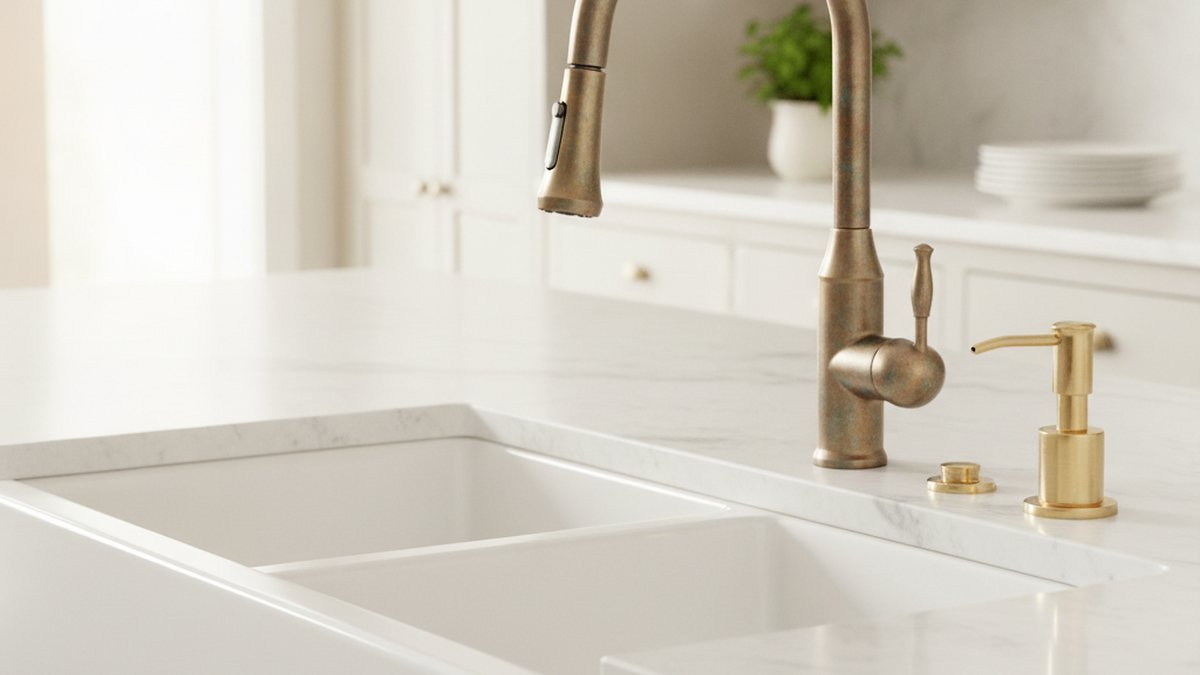
If you’ve been reading waterstone kitchen faucet reviews trying to figure out whether a four-figure faucet is a smart buy or a status symbol, here’s the honest answer up front: Waterstone makes one of the heaviest, most durable, most finish-flexible kitchen faucets you can buy in North America — hand-assembled in Murrieta, California from solid forged brass — but you’re paying a real premium for that, and not every kitchen needs it. This review breaks down who should buy one, where the money actually goes, how the main series compare, and what the smart alternatives are if the price makes you wince.
Who is a Waterstone kitchen faucet actually worth it for?
A Waterstone faucet is worth it if you want a premium, solid-brass faucet that’s made in the USA, offered in 30+ finishes, and designed to match a full set of sink accessories. It’s overkill if your main goal is simply “a faucet that works and doesn’t leak.”
Think about it in terms of three buyer types:
- The forever-kitchen remodeler. You’re spending $40k+ on a kitchen you plan to keep for 20 years. A $1,200 faucet is roughly 3% of the budget, and you want every piece to coordinate. Waterstone is built for you.
- The finish-obsessed buyer. You want unlacquered brass that patinas, or satin black gold, or a hard-to-find weathered copper — not the same five finishes every big-box brand sells. Waterstone’s finish catalog is its single biggest draw.
- The value-first homeowner. You want a solid faucet for a reasonable price and don’t care who made it or whether the soap dispenser matches. You should probably not buy Waterstone — and that’s a legitimate choice, not a downgrade.
The faucet itself is excellent in all three cases. The question “is it worth it” is really a question about which buyer you are.
Why are Waterstone faucets so expensive compared to Delta or Moen?
Waterstone faucets cost more because they’re forged from solid brass, hand-assembled in California, finished in-house in dozens of options, and backed by a limited lifetime warranty — versus mass-produced faucets that use more zinc and plastic internals and build in far larger volumes.
Here’s where the money genuinely goes, and where it mostly buys you bragging rights:
- Material (real value): Waterstone uses heavy forged and cast brass through the body and spout. Many sub-$300 faucets use zinc alloy or plastic in places you can’t see, which is fine for a decade but not for “heirloom” durability.
- Made in USA (real value to some): Casting, machining, finishing, and assembly happen in Murrieta, CA. That supports domestic manufacturing and tends to mean better part availability years later — but it also raises labor cost dramatically.
- Finish range (real value): 30+ finishes including unlacquered/living finishes that age over time. This is extremely hard to find at any other brand.
- Brand and exclusivity (mostly intangible): Waterstone sells largely through kitchen showrooms and designers, not Home Depot. Part of the price is the premium positioning itself.
The internal valve is the part people forget to ask about. Waterstone uses high-quality ceramic disc cartridges like nearly every modern faucet — the same core technology you’ll find in a $200 faucet. If you want to understand why the cartridge matters more than the badge, our deep dive on whether a brass faucet valve cartridge is really worth it versus ceramic is worth a read before you spend big.
How do the main Waterstone kitchen faucet series compare?
The short version: pick Annapolis or Fulton for traditional/farmhouse kitchens, Gantry or Parche for modern industrial looks, and the PLP (Positive Lock Pull-Down) line if you want the most convenient everyday pull-down. They share the same build quality; the difference is styling and spray mechanism.
| Series | Best for | Spray style | Typical price (2026) | Standout trait |
|---|---|---|---|---|
| Annapolis | Traditional & transitional kitchens | Pull-down | $1,100–$1,600 | Classic lines, huge finish range |
| Fulton | Farmhouse / cottage | Side-spray or pull-down | $1,000–$1,500 | Vintage cross-handle options |
| Gantry | Modern / industrial | Articulating / pull-down | $1,300–$2,200 | Exposed-bridge industrial look |
| Parche | Contemporary minimalist | Pull-down | $1,200–$1,800 | Clean single-handle silhouette |
| Contemporary PLP | Everyday workhorse kitchens | Positive-lock pull-down | $900–$1,400 | Spray head locks in place, no droop |
The “Positive Lock” detail on the PLP line is a genuinely useful feature: the pull-down wand clicks firmly back into the dock instead of relying on a magnet that weakens over time. If you’ve ever owned a pull-down faucet whose spray head slowly started sagging out of its holster, you’ll appreciate it.
What about the Waterstone “suite” — the air switch, soap dispenser, and filtration?
Waterstone’s real pitch isn’t a single faucet; it’s a coordinated suite where the faucet, air switch for the disposal, soap/lotion dispenser, hot water tap, and filtration faucet all share the exact same finish. That matching is the main reason designers specify the brand.
This matters more than it sounds. Most people buy a beautiful main faucet, then screw a mismatched chrome soap pump and a plastic disposal button into the deck right next to it. Waterstone lets you finish the whole sink deck in one cohesive look — an air switch instead of a wall disposal switch, a matching filtration faucet, and a hot-only tap for tea and coffee. If you’re the kind of person who notices that the soap dispenser doesn’t match, this is the feature you’re actually paying for.
Are Waterstone kitchen faucets reliable, and what does the warranty cover?
Yes — Waterstone faucets are highly reliable thanks to solid-brass construction and ceramic disc cartridges, and they carry a limited lifetime warranty to the original residential owner covering materials and workmanship, with a separate finish warranty that excludes “living” (unlacquered) finishes meant to patina.
A few things worth knowing before you buy:
- Living finishes age on purpose. Unlacquered brass and copper will darken and develop a patina. That’s a feature, not a defect — and it’s specifically not covered under the finish warranty because it’s expected behavior. If you want a finish that stays mirror-bright forever, choose a lacquered or PVD option instead.
- Flow rate meets U.S. standards. Kitchen models are built to ship compliant with federal and state flow limits (commonly 1.8 GPM, or 1.5 GPM for California/CALGreen regions). You can usually request an aerator to match your local code.
- Parts are serviceable. Because the brand is U.S.-based and sells through showrooms, cartridges and spray wands are generally easy to source years later — a real advantage over discontinued import models.
No faucet is immune to a worn cartridge or an O-ring drip after enough years. The upside with a solid-brass body is that a repair is almost always just a cartridge swap, not a replacement faucet. If you want to understand how that same repair logic applies to other faucets, our guide on fixing a leaky bathroom faucet yourself walks through the exact cartridge-and-O-ring process.
How does Waterstone stack up against other premium kitchen faucets?
Against other premium brands, Waterstone wins on finish variety and made-in-USA solid-brass construction, roughly ties on durability, and loses on smart/touchless technology and street-level availability. European brands like Hansgrohe and Grohe tend to offer sleeker engineering and electronic features at a somewhat lower price.
| Brand | Made in | Finish options | Tech features | Typical price | Best for |
|---|---|---|---|---|---|
| Waterstone | USA | 30+ (incl. living finishes) | Minimal | $900–$2,500 | Coordinated luxury suites |
| Hansgrohe | Germany/import | ~5–8 | sBox, select buttons | $400–$900 | German engineering, smooth pull-down |
| Grohe | Germany/import | ~4–6 | Touchless, SmartControl | $300–$800 | Tech + reliability value |
| Brizo | USA/import | ~6–10 | SmartTouch, voice | $500–$1,200 | Designer looks with touch tech |
If sleek daily usability and a lower price matter more to you than finish variety, it’s worth comparing specific models directly. Our Hansgrohe Zesis kitchen faucet review and our breakdown of whether the Grohe Eurosmart pull-out is worth buying both cover faucets that deliver excellent everyday performance for a fraction of Waterstone’s price. The trade-off is simple: you give up the finish range and the made-in-USA brass body, and you gain a lot of saved money and, in some cases, touchless tech.
What should you check before you buy a Waterstone faucet?
Before you commit, confirm the number of mounting holes your sink or countertop has, your spout-height clearance under upper cabinets or a window, and whether your water pressure can handle the flow — because a four-figure faucet is a painful thing to order in the wrong configuration.
- Count your deck holes. Waterstone single-hole faucets need one hole; add a soap dispenser, air switch, or side spray and you’ll need more. Decide on the full suite before you drill.
- Measure spout clearance. Many Waterstone spouts are tall. Measure from the deck to the bottom of any upper cabinet or window sill so the handle has room to lift fully.
- Check your supply lines and shut-offs. Make sure your under-sink valves and supply connectors match. Getting supply-line sizing right saves a return trip — the same care we lay out in our guide to getting faucet supply line size right.
- Plan the removal of your old faucet. If you’re replacing an existing unit, budget time to get the old base off cleanly; our walkthrough on removing a kitchen faucet base without wrecking your sink covers the stuck-nut scenarios.
- Pick lacquered vs. living finish deliberately. This is irreversible in practice. If you want zero maintenance, avoid unlacquered.
Our verdict: buy it for the right reasons
After weighing the construction, finish range, warranty, and price, our take is that a Waterstone kitchen faucet is absolutely worth it for a forever kitchen where coordination and made-in-USA solid brass matter to you — and a hard pass if you’re buying purely on function, where a $300–$600 faucet will serve you just as well for 10–15 years. It’s a specification-grade luxury product, and it rewards the buyer who values what it specifically does better: finishes, suites, and heirloom build.
If the price is the only thing holding you back and you love the look, remember you can get a similar high-end feel at a lower tier by choosing one standout faucet and skipping the full matching suite — or by shopping a finish-focused model from a value brand. For budget-conscious comparison shopping in the same spirit, see our roundup of faucets that actually last under $100 to calibrate what “cheap but good” really looks like today.
FAQ
Where are Waterstone kitchen faucets made?
Waterstone kitchen faucets are made in the United States — specifically Murrieta, California — where the company casts, machines, finishes, and hand-assembles its faucets. This domestic manufacturing is a core part of the brand’s identity and one reason parts remain available years after purchase.
Are Waterstone faucets worth the high price?
They’re worth it if you value solid-brass construction, 30+ finish options, a matching sink suite, and made-in-USA quality for a long-term kitchen. They’re not worth it if you simply want a dependable faucet, since a $300–$600 model from Grohe, Hansgrohe, or Moen delivers similar day-to-day performance for far less money.
Do Waterstone faucets come with a lifetime warranty?
Yes. Waterstone offers a limited lifetime warranty to the original residential owner covering defects in materials and workmanship, plus a separate finish warranty. Note that “living” unlacquered finishes are intentionally excluded from the finish warranty because they’re designed to patina and change over time.
What finishes do Waterstone kitchen faucets come in?
Waterstone offers more than 30 finishes, including polished and satin chrome, nickel, brass, bronze, copper, black, and unlacquered “living” finishes that develop a patina. This range is the brand’s biggest differentiator — most competitors offer only a handful of finish choices.
Can I get the Waterstone look for less money?
Yes. Buy a single statement faucet and skip the full matching suite, or choose a finish-forward model from a value brand like Grohe or Hansgrohe. You’ll sacrifice the solid-brass body and the exact finish-matched accessories, but you can cut the cost by 60–75% while keeping a high-end appearance.
Do Waterstone faucets use standard cartridges and parts?
Yes. Waterstone faucets use ceramic disc cartridges like most modern faucets, and because the brand is U.S.-based and showroom-supported, replacement cartridges and spray wands are generally easy to source. Most repairs are a simple cartridge swap rather than a full faucet replacement.
Author note: This review was written by the wewefaucet product team, which has installed, tested, and serviced hundreds of residential and premium kitchen faucets. wewefaucet (www.wewefaucet.net) is a dedicated faucet and bathroom-fixture retailer; our recommendations weigh real build quality, cartridge type, flow-rate compliance with U.S. and California (CALGreen) standards, and manufacturer warranty terms — not just brand reputation. We are not affiliated with Waterstone; pricing reflects typical 2026 U.S. street prices and may vary.
您好!please sign in